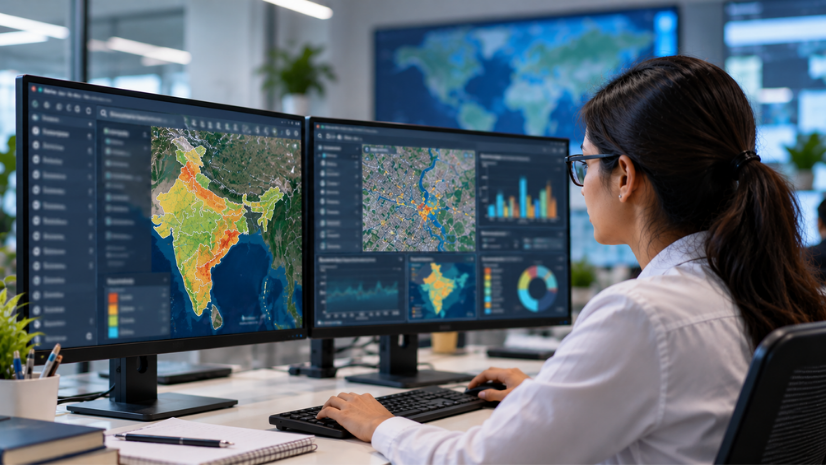
The Growing Need for Data-Driven Policing in India
Indian cities are growing faster than the systems built to keep them safe.
As populations concentrate in urban centers, crime patterns become more complex, more mobile, and harder to anticipate through traditional methods. A beat constable patrolling a fixed route cannot see the spatial clusters forming three neighbourhoods over. A manual incident log reviewed at month end reveals trends that have already hardened into problems. And resources spread too thin across a city have no way of anticipating where they will be needed next.
For decades, Indian policing relied on reactive models: respond to reported crime, investigate after the fact, and deploy based on experience and intuition. This model worked when crime patterns were relatively stable and cities were manageable in scale. Neither condition holds today.
Spatial analytics offers a fundamentally different approach. By combining location data, historical incident records, demographic information, and real-time feeds into an analytical environment where patterns emerge visually and predictively, spatial analytics shifts policing from reactive to proactive. It gives police officers, analysts, and field teams the situational intelligence to make better decisions faster, with evidence rather than estimation.
What Is Spatial Analytics in Crime Analysis?
Understanding Spatial Analytics and GIS
Spatial analytics is the discipline of applying analytical methods to location-referenced data to reveal patterns, relationships, and trends that are invisible in tabular or textual form. In crime analysis, it means combining incident data with geographic context: mapping where crimes occur, when they cluster, what environmental factors correlate with crime concentration, and how criminal activity evolves across time and space.
GIS provides the platform for this work. It integrates crime records, census demographics, road networks, point-of-interest data, surveillance coverage maps, and real-time sensor feeds into a single spatial environment where analysts can query, visualize, and model.
How It Differs from Traditional Crime Analysis
Traditional crime analysis produces reports. A station logs incidents by type and date. Reports are compiled monthly. Senior officers review aggregated numbers. Patterns are identified weeks or months after they form.
Spatial analytics produces intelligence. Crime incidents are geocoded and mapped the moment they are entered. Hotspot detection algorithms identify clustering before patterns reach reportable thresholds. Predictive models flag high-risk times and locations before incidents occur. Analysts share interactive dashboards rather than static spreadsheets. The difference is not just speed. It is the shift from describing what happened to anticipating what will happen next.
Why Indian Cities Need Spatial Analytics for Policing
Rapid Urbanization and Crime Complexity
India’s rapidly growing cities generate complex, dynamic crime environments that simple record systems cannot parse. High-density neighbourhoods, mixed land use, shifting population demographics, and expanding informal settlements all create conditions where crime concentrates, migrates, and adapts in ways that historical averages miss. Spatial analytics makes these dynamics visible by revealing geographic patterns rather than city-wide totals.
Need for Real-Time Crime Monitoring
Police officers need situational awareness that reflects current conditions, not last month’s data. Esri India’s GIS-powered law enforcement solutions enable real-time incident mapping, live dashboards integrating field officer locations and active incident data, and mobile apps that give officers on the ground immediate access to historical incident patterns in their vicinity.
Resource Constraints and Smarter Deployment
Indian police forces manage large jurisdictions with finite personnel and resources. Spatial analytics makes resource allocation evidence-based: directing patrol concentration to high-risk zones and times, routing patrol vehicles along routes that maximize coverage of hotspot areas, and enabling officers to evaluate the impact of deployment changes against measured crime outcomes.
Key Applications of Spatial Analytics in Crime Analysis
Crime Hotspot Mapping
Hotspot mapping is the foundation of spatial crime analysis. Using statistical techniques including kernel density estimation and Getis-Ord spatial autocorrelation (available in ArcGIS Pro), crime analysts identify clusters of incidents that are statistically significant rather than randomly distributed.
For Indian city police departments, hotspot maps reveal which neighbourhoods, intersections, and time periods concentrate the highest crime risk. These maps drive patrol assignment, response planning, and community policing priorities. Updated continuously as new incidents are recorded, they reflect current crime patterns rather than historical baselines.
Predictive Policing and Crime Forecasting
Predictive models in GIS go beyond describing where crime has occurred to forecasting where it is most likely to occur next. By integrating historical incident patterns, time-of-day and day-of-week rhythms, weather conditions, event schedules, and land use characteristics, spatial models generate risk indices for specific locations and time windows.
Esri India’s spatial analytics capabilities support the development and deployment of these predictive models within the ArcGIS environment, enabling crime analysts to produce crime forecast maps that give officers actionable foresight rather than historical hindsight.
Patrol Planning and Resource Allocation
GIS network analysis supports patrol route optimization by modeling how patrol units can cover high-risk zones most efficiently given real-world road networks, traffic conditions, and shift schedules. Esri India’s patrol operations solutions enable police agencies to design patrol beats geographically, balance workload across patrol units, and continuously refine deployment based on measured crime outcomes.
For resource-constrained police forces managing large urban jurisdictions, this spatial intelligence translates directly into better coverage of high-risk areas without increasing headcount.
Real-Time Crime Monitoring and Dashboards
ArcGIS Dashboards give police chiefs a live, spatially integrated operational picture. Incident feeds from records management systems, field officer locations from mobile tracking, and active incident status all appear on a single operational map that updates in real time.
Senior officers monitoring command centers can see exactly where active incidents are concentrated, which units are closest, and where high-risk zones are experiencing unusual activity, enabling faster deployment decisions and better cross-unit coordination during major events or emerging crime surges.
Incident Analysis and Investigation Support
GIS enables investigators to analyze the spatial relationships between incidents that may appear unrelated in tabular records. Crimes committed by a single offender often show spatial patterns: proximity to the offender’s home base, movement along specific routes, concentration in familiar target environments.
ArcGIS Crime Analysis tools support link analysis, buffer analysis around suspect locations, and geographic profiling that helps investigators identify probable offender anchor points and prioritize investigative leads based on spatial evidence. ArcGIS can also analyze cell phone records, financial transactions, and other investigative data sources to reveal spatial patterns across criminal networks.
How Spatial Analytics Improves Policing Decisions
Faster Decision-Making with Real-Time Insights
When command and control centres can see live incident density, active patrol locations, and emerging hotspot activity on a single dashboard, deployment decisions that previously required briefing cycles and manual report compilation can be made in minutes. Real-time spatial intelligence compresses the decision cycle from hours to moments, enabling responses calibrated to current conditions rather than yesterday’s briefing.
Evidence-Based Policing Strategies
Spatial analytics replaces intuition and experience as the primary basis for policing strategy with quantitative, spatial evidence. Crime reduction interventions can be evaluated against measured geographic crime outcomes: did the additional patrol in a hotspot zone reduce incidents in that zone or displace them to adjacent areas? GIS makes these evaluations possible at the neighbourhood level, enabling continuous refinement of strategies based on what actually works spatially.
Enhanced Coordination Across Departments
Crime does not respect jurisdictional or departmental boundaries. Shared GIS dashboards accessible to traffic police, detective branches, patrol units, and command staff enable multi-department coordination based on a common operational picture. When every department works from the same spatial intelligence platform, information sharing improves and response coordination accelerates.
Technologies Powering Spatial Crime Analytics
GIS Platforms and Mapping Tools
Esri’s ArcGIS is the industry-standard GIS for law enforcement globally, supporting the full spectrum of crime analysis workflows from basic incident mapping through advanced predictive modeling. ArcGIS integrates with police Records Management Systems (RMS) and Computer-Aided Dispatch (CAD) systems to automate data import and ensure that crime maps reflect current incident data continuously.
Integration of AI and Predictive Models
GeoAI capabilities within ArcGIS apply machine learning to spatial crime data, identifying patterns that statistical methods may miss and generating risk scores at granular geographic levels. AI-enhanced pattern detection supports both tactical analysis of short-term crime clusters and strategic analysis of long-term crime trends across city areas.
IoT, CCTV, and Real-Time Data Feeds
Modern urban surveillance infrastructure, including CCTV networks, vehicle tracking systems, and smart city sensor networks, generates continuous real-time data streams that can be integrated into GIS crime analysis platforms. ArcGIS GeoEvent Server ingests these live data feeds, enabling real-time alerts when sensor data indicates unusual activity in monitored zones.
Use Cases of Spatial Analytics in Indian Cities
Smart City Surveillance Systems
India’s Smart Cities Mission has deployed Integrated Command and Control Centres (ICCCs) in cities including Varanasi, Gurugram, Kanpur, and Bhopal. These command centers integrate CCTV feeds, traffic sensors, emergency response data, and civic incident reports into unified operational dashboards. When powered by ArcGIS, these dashboards provide the spatial context that transforms raw sensor data into actionable law enforcement intelligence.
Traffic and Crime Correlation Analysis
GIS enables analysts to overlay traffic flow data, road network characteristics, and crime incident patterns to identify spatial relationships between transportation infrastructure and crime. High-crime intersections, routes associated with vehicle theft or snatching, and corridors where low traffic density creates vulnerability all emerge from spatial correlation analysis that tabular data cannot reveal.
Emergency Response Optimization
Spatial analytics models how emergency response time varies across a city based on unit location, road network, traffic conditions, and incident location. Police agencies can use these models to optimize patrol positioning for minimum response time to high-risk zones, test the impact of station additions or relocations before committing resources, and track actual versus modeled response performance over time.
Benefits of Spatial Analytics for Law Enforcement
Improved Crime Prevention
Hotspot mapping and predictive forecasting enable proactive deployment in high-risk areas before crime concentrates rather than after incidents accumulate. Spatial analytics shifts policing from chasing crime to anticipating and preventing it.
Better Resource Utilization
Evidence-based patrol allocation directs limited police resources to where spatial analysis shows they will have the greatest impact. Every deployment decision backed by spatial intelligence is more efficient than one based on historical habit or management intuition.
Increased Public Safety and Trust
Transparent crime mapping shared with communities through ArcGIS Hub builds public trust by demonstrating that policing decisions are data-driven, accountable, and community-aware. Safer neighbourhoods that result from more effective policing compound this trust over time.
Data-Driven Governance
Crime pattern data analyzed spatially supports policy decisions beyond enforcement: identifying where urban infrastructure, lighting, or community program investment will have the greatest safety impact and enabling evaluation of those investments against measured crime outcomes.
Challenges in Implementing Spatial Analytics in Policing
|
Challenge |
How Esri India Helps |
| Data Quality and Availability | ArcGIS provides data management and validation tools that standardize geocoding, resolve incomplete address records, and automate import from RMS and CAD systems, improving the data quality that spatial analysis requires |
| Privacy and Ethical Concerns | ArcGIS Enterprise supports role-based access controls, data anonymization capabilities, and audit trail frameworks that enable responsible use of spatial crime data within appropriate governance structures |
| Skill Gaps and Training | Esri India’s training programs offer specialized courses in crime analysis, spatial statistics, and law enforcement GIS workflows, building the analytical capability that police agencies need to operate spatial analytics effectively |
| Integration with Legacy Systems | ArcGIS supports open API integration with existing RMS, CAD, and other law enforcement enterprise systems, enabling spatial analytics to be layered on top of existing operational technology without requiring full system replacement |
The Future of Crime Analysis with Spatial Analytics in India
AI-Driven Predictive Policing
As GeoAI capabilities mature within ArcGIS, predictive crime models will become more accurate, more granular, and more automated. Machine learning models trained on multi-year crime datasets, integrated with real-time urban data feeds, will generate dynamic risk forecasts that update continuously as conditions change, giving officers truly forward-looking operational intelligence.
Real-Time Smart Policing Systems
The convergence of 5G connectivity, IoT sensor networks, and GIS-powered command centers will create fully integrated real-time policing environments where every patrol unit, surveillance camera, and incident report contributes to a continuously updated spatial picture of city safety. Response systems will shift from human-initiated to alert-triggered, reducing both response time and the cognitive burden on individual officers.
Safer and Smarter Cities
As spatial crime analytics become embedded in urban governance frameworks, the boundary between law enforcement and city planning will blur in productive ways. Crime pattern data will inform infrastructure investment, lighting decisions, park design, and transportation planning, creating cities that are physically configured to reduce crime opportunity rather than managing it after the fact.
Conclusion: Towards Smarter, Safer Cities with Spatial Analytics
India’s cities cannot be policed with yesterday’s methods. The complexity, speed, and spatial distribution of urban crime demand analytical capabilities that traditional policing structures were never designed to provide.
Spatial analytics represents the shift from reactive to predictive and proactive policing. It gives officers evidence where they had intuition, patterns where they had anecdotes, and foresight where they had hindsight.
Esri India’s ArcGIS law enforcement solutions provide the full spatial intelligence platform that Indian police agencies need: crime hotspot analysis, predictive modeling, real-time dashboards, mobile field tools, investigative support, and community engagement capabilities, all integrated in a single spatial environment.
The technology is available. The choice is whether to use it proactively and make Indian cities safer before crime hardens into patterns, or reactively and keep responding after the crime has taken place.
Ready to bring spatial analytics to your law enforcement operations? Connect with Esri India to learn more.
Frequently Asked Questions
What is spatial analytics in crime analysis and how does it help policing in India?
Spatial analytics combines location data, historical crime records, and real-time information to reveal where and when crime concentrates, predict where it is likely to occur next, and guide deployment of police resources. In India, it shifts policing from reactive incident response to proactive, evidence-based crime prevention across complex urban environments.
How is GIS used for crime analysis and hotspot mapping in Indian cities?
GIS geocodes crime incidents onto maps and applies statistical tools like kernel density estimation and spatial autocorrelation to identify hotspot clusters. Police analysts use these maps to guide patrol planning, community policing priorities, and executive decision-making. Esri’s ArcGIS is the industry standard for this work, supporting both tactical daily analysis and strategic long-term crime trend assessment.
How does ArcGIS support predictive policing and patrol operations?
ArcGIS integrates historical crime data, time patterns, demographic data, and environmental factors to generate risk forecasts for specific locations and time windows. GIS network analysis supports patrol route optimization and resource allocation based on real-time risk maps. ArcGIS Dashboards give command centres live situational awareness across their jurisdiction, enabling faster and more informed deployment decisions.
How does spatial analytics help combat urban crime in India’s smart cities?
Smart city Integrated Command and Control Centres powered by ArcGIS integrate CCTV feeds, traffic data, emergency response records, and civic incident reports into spatially referenced operational dashboards. Officers see where active incidents are concentrated, where patrol units are positioned, and where risk is building, enabling coordinated, evidence-based responses across departments in real time.
What are the challenges of implementing GIS-based crime analysis in India?
The main challenges are incomplete or inconsistently geocoded crime data, privacy and governance requirements for sensitive spatial records, skill gaps in GIS and spatial analytics within police departments, and integration complexity with existing records management systems. Esri India addresses these through data management tools, role-based access frameworks, structured training programs, and open API integration that connects ArcGIS to existing police IT infrastructure.
Written by
Esri India Marketing