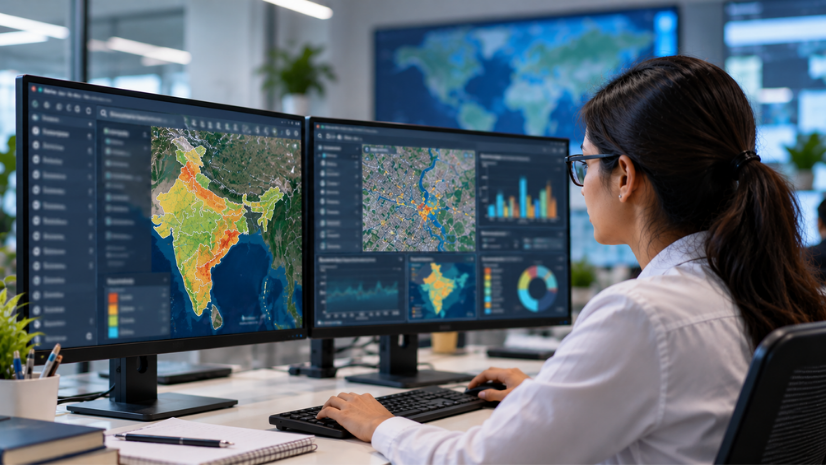
GIS for coastal zone management in India means using geographic information system (GIS) technology to map, monitor, and manage the dynamic interface between land and sea, from delineating high tide lines and coastal hazard zones to tracking shoreline change, monitoring mangrove health, planning marine spatial use, and supporting port-led development along India’s 7,517-kilometer coastline.
As India pursues its Blue Economy ambitions alongside coastal conservation and climate resilience, GIS is the spatial platform that unifies these competing and complementary demands into a single, evidence-based planning system.
India’s 7,517 km Coastline and the Blue Economy Promise
India’s coastline touches nine states and four Union Territories, shelters 12 major ports and over 200 non-major ports, supports the livelihoods of millions of fishers, and hosts globally significant ecosystems including the Sundarbans, the Gulf of Mannar, the Lakshadweep reefs, and the mangroves of Bhitarkanika and Pichavaram.
India, with its 7,500 km coastline, 14,500 km of navigable waterways, and access to the Indian Ocean, already contributes about 4% to India’s GDP through key sectors like fisheries, aquaculture, shipping, tourism, and offshore oil and gas exploration. Over 95% of India’s trade by volume and 68% by value is handled through maritime transport.
The scale of India’s maritime economy also means that competing pressures on coastal space are intensifying. Urbanisation, port expansion, offshore energy, fishing ground access, tourism infrastructure, climate-driven erosion, and mangrove loss all vie for the same narrow coastal strip. Managing these pressures rationally, without spatial intelligence, is impossible.
What Is GIS for Coastal Zone Management?
GIS for coastal zone management is the application of geographic information system technology to acquire, store, analyze, and visualize spatial data about the coastal zone and marine environment, enabling planners and regulators to make evidence-based decisions about development, conservation, and disaster risk.
It brings together satellite imagery, aerial surveys, bathymetric data, oceanographic records, administrative boundaries, land use maps, ecological layers, and real-time sensor feeds into a single spatial environment. The result is a continuously updated, multi-dimensional picture of the coast that supports regulatory compliance, environmental monitoring, infrastructure planning, and community livelihood protection simultaneously.
India’s Coastal Governance: From CRZ to ICZM
India’s primary coastal regulatory instrument is the Coastal Regulation Zone (CRZ) Notification, most recently updated in 2019. The CRZ Notification 2019 seeks to conserve and protect the unique environment of coastal stretches and marine areas, besides livelihood security to fisher communities and other local communities, and to promote sustainable development based on scientific principles, taking into account the dangers of natural hazards and sea-level rise due to global warming.
CRZ 2019 represents a gradual shift toward Integrated Coastal Zone Management (ICZM) and away from the traditional regulatory line approach. It recognizes the knowledge products developed by NCSCM and Survey of India, including High Tide Line (HTL), Low Tide Line (LTL), hazard line, Ecologically Sensitive Area (ESA), and Critically Vulnerable Coastal Area (CVCA) maps, as key inputs for states and UTs to prepare Coastal Zone Management Plans.
The Coastal Information System framework mandates that each authorized agency prepare a coastal information system for its state or UT on a GIS platform, from which Coastal Zone Management Plans can be generated as required. This GIS platform covers data acquisition, storage, analysis, modeling, and management of geospatial data across the coastal zone.
The World Bank-supported ICZM project, implemented through NCSCM with pilot states of Gujarat, Odisha, and West Bengal, demonstrated what spatially grounded coastal governance can deliver. The project achieved mapping and delineation of over 7,800 km of Coastal Hazard Line for India’s entire mainland coast based on the latest climate change projections, and supported the restoration of 19,500 hectares of mangroves, enhancing coastal carbon sinks and protecting coastal assets and communities against climate and disaster risks.
The completed hazard line map of the entire coast of India, based on aerial photography of 80,000 square kilometers, incorporates data on 150 major and minor ports, coastal ESAs covering approximately 34,160 square kilometers, CVCAs, erosion, flooding, tidal waves, sea-level rise, HTL, and LTL to support all coastal states and UTs in preparing disaster management plans and managing coastal vulnerability. NCSCM also established CoMBINe, a national digital repository of more than 11,000 marine species.
How GIS Powers Integrated Coastal Zone Management
The spatial workflows that deliver ICZM in India span from satellite imagery analysis to field survey capture to real-time monitoring, all integrated within the ArcGIS platform.
Shoreline change detection
ArcGIS Image processes multi-decadal satellite imagery archives to detect shoreline position changes at the meter scale. By comparing coastal geometry across time series of Sentinel, Landsat, and Resourcesat images, analysts can measure erosion rates at hotspots like Kerala’s northern coastline, Odisha’s Mahanadi delta, and the Andhra Pradesh coast south of the Krishna river mouth. This spatial evidence directly informs where coastal protection investments are most urgently needed.
Mangrove and coral reef monitoring with GeoAI
ArcGIS Pro applies deep learning-based image classification models from Indo ArcGIS Living Atlas to monitor mangrove extent and canopy health across the Sundarbans, Bhitarkanika, Pichavaram, and the Gulf of Kachchh. Annual change detection compares current mangrove extent against baseline maps, identifying degradation zones that require restoration intervention under the MISHTI mangrove restoration programme. For coral reef health monitoring in the Gulf of Mannar, Andaman and Nicobar Islands, and Lakshadweep, spectral analysis of high-resolution satellite imagery detects bleaching events and structural damage months before ground surveys could confirm the same findings.
Coastal vulnerability and hazard mapping
ArcGIS Pro’s multi-criteria spatial analysis combines sea-level rise projections, storm surge models, coastal slope, shoreline change rates, sediment characteristics, and human settlement density into Coastal Vulnerability Index maps at the block level. This CVCA framework directly feeds into district disaster management plans and informs where cyclone shelters, coastal embankments, and mangrove buffers deliver the highest risk-reduction value.
Field survey and community monitoring
ArcGIS Survey123 and ArcGIS Field Maps enable coastal beat officers, forest department staff, and community-based monitoring volunteers to capture GPS-tagged observations of encroachments, coastal dumping, illegal constructions within CRZ limits, and mangrove cutting incidents directly from the field. This distributed surveillance capability extends regulatory reach far beyond what a centralized inspectorate can achieve.
Real-time coastal monitoring
ArcGIS Velocity ingests live data from tide gauges, wave buoy networks managed by INCOIS, and coastal water quality sensors into a spatially indexed operational dashboard. During cyclone events, real-time storm surge forecasts overlaid with populated coastal areas enable district administrations to prioritise evacuation decisions with spatial precision.
GIS for the Blue Economy: Beyond Conservation
India’s Blue Economy spans fisheries, aquaculture, ports and shipping, offshore energy, deep sea exploration, and coastal tourism. Each sector has a spatial dimension that GIS makes manageable.
Fisheries and PMMSY
India’s fish production grew from 96 lakh tonnes in 2013-14 to around 195 lakh tonnes in 2024-25, a 104% increase. The Pradhan Mantri Matsya Sampada Yojana, with a planned investment of ₹20,050 crore, aims to drive a blue revolution through sustainable, technology-enabled fisheries and aquaculture. GIS supports PMMSY by mapping fish landing centers, cold chain infrastructure, and aquaculture cluster locations against road access, power availability, and coastal ecology, identifying where new infrastructure investments will generate the greatest economic return for fishing communities.
Sagarmala and port-led development
The Sagarmala Programme promotes port-led development, coastal shipping, inland waterways, and industrial clusters, with nearly 800 projects identified up to 2035. ArcGIS Pro and ArcGIS GeoBIM support Sagarmala workflows at every stage: port site selection overlaid with bathymetric data and ecological exclusion zones, hinterland road and rail connectivity planning to reduce logistics costs, and port construction monitoring through drone surveys managed by Site Scan for ArcGIS. Connecting Sagarmala port nodes to the PM Gati Shakti National Master Plan’s GIS layer provides the multimodal planning context that ensures port investments generate inland economic value, not just maritime throughput.
Offshore wind and spatial conflict resolution
India plans to auction 37 GW of offshore wind site leases through FY 2030, primarily off Gujarat and Tamil Nadu. GIS-based site analysis optimises offshore wind and tidal energy projects, minimising environmental impact, and bathymetric mapping ensures safe and sustainable seabed utilisation. ArcGIS Pro overlays wind resource data, water depth contours, shipping lane designations, fishing ground boundaries, coral and seagrass exclusion zones, and marine protected area buffers simultaneously, making it the only practical tool for resolving the spatial conflicts that offshore wind development triggers between energy, ecology, and fishing communities.
Marine Spatial Planning: India’s Emerging Governance Frontier
Marine Spatial Planning (MSP) is the process of analyzing and allocating the spatial and temporal distribution of human activities in marine areas to achieve ecological, economic, and social objectives. India is among the first developing countries to pilot MSP at a subnational level.
The MSP initiative for Puducherry began in October 2022, with stakeholder engagement and the establishment of goals and a vision for the future. A spatial database was launched in a GIS environment in February 2023, laying the groundwork for analyzing impacts and interrelationships. A Web GIS-based dashboard named SAHAV was developed, providing decision-makers with comprehensive details and data related to various project aspects, progress, and underlying parameters. As of 2025, the MSP process has advanced with stakeholder meetings playing a crucial role in refining zoning strategies and implementation frameworks.
Lakshadweep’s MSP pilot faces an even more complex multi-use environment: subsistence fishing, coral reef tourism, shipping, proposed offshore wind development, and inter-island ferry connectivity all compete for the same marine territory within a tiny archipelago. GIS-based spatial zoning, where each marine activity type is mapped against resource availability and ecological sensitivity, is the only credible mechanism for resolving these conflicts while preserving the reef ecosystems that underpin the entire local economy.
ArcGIS Marine provides the purpose-built marine GIS environment that supports MSP workflows in India, handling bathymetric surfaces, tidal datum transformations, marine zoning overlays, and oceanographic data integration in a single platform designed for the unique spatial challenges of the coastal and marine environment.
How Indian Agencies Are Using GIS for the Coast
NCSCM and MoEFCC have institutionalised GIS as the foundation for India’s Coastal Zone Management Plan framework, mandating that every coastal state prepare its CZMP through a GIS-based Coastal Information System. The completed hazard line, ESA, and CVCA maps are maintained as spatial datasets that feed directly into development permission decisions and disaster risk reduction planning.
INCOIS uses GIS-integrated ocean observation systems to produce real-time and forecast products for Indian fishers, including Potential Fishing Zone advisories that identify where fish concentrations are likely based on sea surface temperature, chlorophyll, and current patterns. These spatially indexed advisories, delivered to fishers via SMS and the INCOIS app, directly translate oceanographic GIS analysis into livelihood outcomes for India’s three million marine fishers.
NRSC/ISRO maintains multi-temporal coastal land use and mangrove extent datasets through the National Wetland Inventory and Assessment and the National Mission for Green India, providing the authoritative satellite-derived spatial baselines against which change detection analysis is calibrated.
State coastal management authorities in Kerala, Odisha, Gujarat, and West Bengal have built state-level coastal spatial databases under NCSCM guidance, integrating CRZ boundary layers, fishing village locations, heritage zone buffers, and port operation zones into single platforms that district collectors and environment departments use for development clearance decisions. Explore Esri India’s Ports and Maritime solutions for coastal and marine management.
Benefits for Communities, Industries, and the Environment
For coastal communities
Real-time cyclone and storm surge alerts through INCOIS and SDMA dashboards powered by ArcGIS Velocity enable timely evacuation decisions that save lives. PMMSY fisheries infrastructure sited using GIS analysis reaches communities with the greatest need and the best logistics connectivity.
For port and maritime industries
Sagarmala project planning grounded in spatial analysis reduces the risk of infrastructure investments that conflict with ecological designations or generate costly regulatory challenges. Bathymetric surveys processed through ArcGIS Reality support port expansion and channel dredging decisions with verifiable spatial accuracy.
For coastal regulators
A GIS-based CZMP system replaces manual regulatory line interpretation with automated, coordinate-based CRZ compliance checking, reducing approval cycle times and eliminating the ambiguity that historically plagued development permission decisions near the coast.
For the environment
Mangrove restoration under MISHTI and ICZM programmes is targeted to the locations where ecological recovery is most feasible and where coastal protection value is highest, using GIS suitability analysis rather than administrative convenience to determine where restoration investments go.
Challenges and the Road Ahead
Keeping spatial databases current
India’s coastline is dynamic. Mangroves grow and retreat. Shorelines migrate. New constructions appear within CRZ limits. Static maps prepared once and left unchanged do not serve regulatory or planning purposes. Annual or bi-annual satellite-based update cycles through ArcGIS Image, combined with field verification through ArcGIS Field Maps, are essential to maintaining the spatial authority that India’s CRZ framework requires.
Cross-sectoral data integration
Fisheries data sits with the Department of Fisheries, port data with the Ministry of Ports, oceanic data with MoES, and ecological data with MoEFCC. For Marine Spatial Planning and integrated Blue Economy governance to work, these datasets need to be accessible on a shared spatial platform. This is a data governance challenge as much as a technical one, and it mirrors the fragmented ministerial responsibility that has historically slowed India’s integrated ocean governance.
Capacity in coastal states and UTs
CRZ compliance and CZMP preparation require GIS-literate staff within state coastal management authorities. Capacity levels vary widely across India’s 9 coastal states and 4 coastal UTs. Building sustainable GIS capability within coastal regulatory bodies is as important as building the national spatial datasets that NCSCM produces.
Deep Ocean Mission spatial layer
India’s Deep Ocean Mission under MoES is generating new bathymetric surveys, hydrothermal vent mapping, and polymetallic nodule resource data from the Indian Ocean floor. As this deep-sea spatial data accumulates, integrating it into a national marine spatial information system through ArcGIS Enterprise will be essential for evidence-based governance of India’s Exclusive Economic Zone resources. India’s coast is simultaneously a conservation priority, a climate frontline, a livelihood foundation for millions, and the backbone of one of the world’s most ambitious maritime economies. GIS is the technology that makes it possible to hold all of these dimensions in view at once, and to make decisions that serve all of them, rather than sacrificing one for another.
FAQs
1.What is Integrated Coastal Zone Management (ICZM)?
ICZM manages the coastal zone as a single interconnected system, addressing ecological, social, and economic objectives together. In India, it uses HTL, hazard line, and ESA maps as the foundation for Coastal Zone Management Plans developed by coastal states through GIS-based Coastal Information Systems.
2.How does GIS help in coastal zone management?
GIS integrates shoreline position, ecological sensitivity, hazard exposure, and land use into a unified planning platform. ArcGIS Image monitors shoreline change from satellite imagery, while ArcGIS Velocity ingests real-time tide gauge and wave sensor data for operational coastal monitoring.
3.What is India’s Blue Economy?
India’s Blue Economy covers fisheries, ports, offshore energy, deep-sea minerals, and coastal tourism, contributing approximately 4% of GDP. Key policy frameworks include the Sagarmala Programme, PMMSY, the Deep Ocean Mission, and the National Offshore Wind Energy Policy.
4.What is the Coastal Regulation Zone (CRZ) in India?
The CRZ Notification 2019 classifies coastal areas into zones based on ecological sensitivity and tidal influence, setting development permissions for each zone. CRZ compliance is determined using HTL and LTL maps prepared by NCSCM and Survey of India.
5.How is GIS used for marine spatial planning in India?
NCSCM’s Puducherry MSP initiative established a GIS spatial database in 2023 to map fishing grounds, shipping zones, coral habitats, and energy development zones. For offshore wind planning, GIS overlays wind resource, bathymetry, and marine exclusion zones to identify developable areas with minimal conflict.
Written by
Esri India Marketing