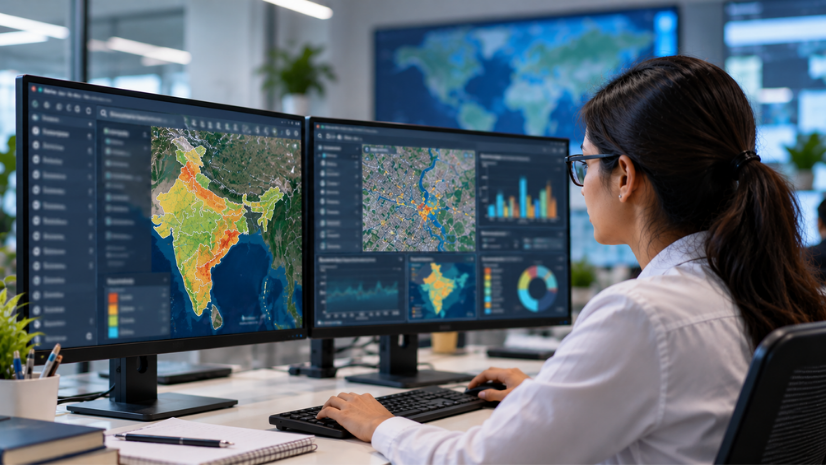
India’s Urban Growth Needs Smarter Planning
India has nearly 10,000 urban bodies. That number tells you something important: urban governance here is not a single challenge. It is ten thousand simultaneous challenges, each with its own population dynamics, infrastructure pressures, and planning gaps.
Cities are expanding faster than the systems built to manage them. A static GIS map created two years ago cannot tell you where unauthorized construction appeared last month. A delayed planning report cannot help a traffic engineer respond to a congestion pattern forming right now. And structured tabular data alone cannot capture the unstructured signals, satellite imagery, social media feeds, sensor streams, that increasingly define how cities actually behave.
This is the shift that GeoAI represents. It moves urban planning from static maps to intelligent, predictive systems. From delayed responses to real-time, proactive decisions. From manual digitization efforts to automated feature and object identification that runs continuously, at scale. And from working only with structured datasets to processing both structured and unstructured data simultaneously.
For India’s cities, GeoAI is not a future capability. It is an urgent one.
What Is GeoAI and Why It Matters for Urban Planning
GeoAI is the integration of artificial intelligence techniques including machine learning, deep learning, computer vision, and natural language processing with geographic information system (GIS) technology. It is what happens when spatial data meets the full power of modern AI.
While traditional GIS is excellent at storing, visualizing, and querying spatial data, GeoAI goes further. It learns from patterns in images, numbers, and text. It can process massive geospatial datasets faster than any team of analysts. It detects hidden spatial relationships that would never emerge from a manual review of maps and tables. And it provides predictive insights that let planners act on what is likely to happen, not just what already has.
In practical terms, GeoAI can automatically identify buildings from satellite imagery, classify land use from aerial scans, detect road cracks from drone footage, or predict which neighbourhoods are most at risk of flooding based on terrain, drainage, and rainfall data, all without requiring a human to manually tag or interpret each data point.
In India’s urban planning, where geospatial data is too vast and complex for traditional methods, this capability makes a huge difference.
Why India Needs GeoAI in Urban Planning
Urban planning in India is inherently complex. It requires integrating multiple datasets simultaneously: transport networks, utility coverage, environmental conditions, population distribution, land use records, building surveys, and more. And it must do so across cities that vary enormously in size, density, geography, and governance capacity.
The key problems that make GeoAI necessary in India include:
Complex urban structures: Indian cities are layered with decades of informal development, overlapping jurisdictions, and incomplete records. Making sense of this complexity requires AI-powered pattern recognition, not manual map reading.
Rapid urbanization and unplanned expansion: Cities are absorbing peri-urban areas faster than master plans can be updated. Unauthorized constructions appear between planning cycles. GeoAI enables continuous monitoring of built-up area change, flagging unauthorized construction as it happens rather than after.
Traffic congestion: India’s urban road networks are under severe stress. Manual traffic analysis cannot keep pace with the daily variability of Indian city traffic. GeoAI models process mobility data in real time, identifying structural congestion causes and predicting hotspots before they form.
Infrastructure stress: Aging water pipes, overloaded power networks, and drainage systems at capacity are widespread challenges. GeoAI enables predictive maintenance by scoring asset risk spatially before failure occurs.
Climate vulnerability: Floods, heat waves, and extreme weather events are intensifying across Indian cities. GeoAI helps map and predict which neighbourhoods are most exposed, enabling targeted resilience investment rather than reactive crisis management.
Effective land use for economic growth and sustainability: India needs to grow economically while preserving agricultural land, green corridors, and water bodies. GeoAI helps planners model land use scenarios that balance development pressure with long-term sustainability, fueling economic growth without sacrificing environmental resilience.
Key Use Cases of GeoAI in Urban Planning
Managing Rapid Urbanization
Urban growth in India does not follow a single pattern. Some cities expand in dense vertical corridors; others sprawl horizontally into agricultural fringes. GeoAI, applied to multi-temporal satellite imagery, can track built-up area expansion at the ward level, identify informal settlement growth, and detect changes in land cover that signal encroachment into protected zones.
Esri India’s imagery and remote sensing capabilities within ArcGIS support deep learning models that automatically classify land cover types from high-resolution imagery, giving planners a continuously updated picture of how their city is actually changing.
Land Use and Urban Growth Prediction
GeoAI models trained on historical land use change data can predict where urbanization pressure will intensify next. By combining population growth projections, transport accessibility, land value trends, and zoning data, these models generate spatial growth probability maps that help planners designate land use proactively rather than after development patterns are already entrenched.
This kind of predictive land use modeling is central to Esri India’s urban and regional planning solutions, which integrate long-range planning with current planning workflows on a shared spatial platform.
Transportation and Mobility Planning
Congestion in Indian cities is rarely just a volume problem. It is a spatial problem. Bottlenecks form at specific intersections, at specific times, because of specific combinations of road geometry, signal placement, and mixed traffic behaviour.
GeoAI models that process real-time mobility data, traffic camera feeds, and GPS traces can identify these structural congestion causes precisely and spatially. Planners can then model how changes to road design, signal timing, or transit routing will shift flow patterns before any physical intervention is made. Esri India’s smart city solutions integrate these live mobility feeds with the city’s GIS base for exactly this kind of analysis.
Demand-Based Infrastructure Planning and Asset Management
Planning infrastructure based on current population density alone misses the question of where demand is actually heading. GeoAI models that combine population growth forecasts, economic activity patterns, and service coverage gaps can generate demand-based infrastructure priority maps, showing where a new water main or substation will serve the most people most efficiently, over the next ten years.
For existing assets, GeoAI enables condition-based maintenance by scoring infrastructure health spatially using sensor data, inspection history, and environmental stress indicators, reducing both reactive repair costs and unplanned service failures.
Environmental Monitoring and Sustainability
GeoAI applied to satellite and drone imagery can automatically detect urban heat islands, map green cover loss, monitor air quality sensor networks, and classify water body health, all continuously and at city scale.
This gives environmental planners a level of spatial resolution and temporal frequency that no manual monitoring program could match. Esri’s ArcGIS spatial analytics platform supports raster analysis, machine learning workflows, and time-series modeling that underpin these environmental applications.
Disaster Reduction and Climate Resilience
Flooding is one of India’s most damaging urban hazards. GeoAI models that integrate elevation data, drainage network capacity, soil moisture, historical flood extents, and real-time rainfall feeds can generate dynamic flood risk maps that update as a monsoon event develops.
Emergency responders can use these maps to pre-position resources, identify vulnerable neighbourhoods for early warning, and simulate different inundation scenarios before a storm arrives, instead of responding to one after it does.
Real-Time Urban Governance Using Live Dashboards
City control rooms across India’s Smart Cities Mission use live dashboards to monitor traffic, utilities, public health, and emergency services simultaneously. GeoAI adds an intelligence layer to these dashboards, automatically flagging anomalies, generating alerts, and prioritizing interventions based on spatial risk models, rather than waiting for a human analyst to spot a trend.
Crowdsourced Data Collection for Citizen-Centric Governance
Urban planning decisions improve when they reflect what citizens actually experience. GeoAI can process crowdsourced data from mobile applications, social media reports, and civic platforms, classifying and geo-locating citizen inputs at scale. This makes it practical to incorporate ground-level observations into planning workflows without creating a manual data entry burden on city staff.
How GeoAI Improves Decision-Making in Cities
Automatic Feature Extraction Using Deep Learning
Deep learning models can scan satellite imagery and automatically identify and classify features: buildings, roads, water bodies, informal settlements, construction sites, vegetation cover, and more. What once required months of manual digitization can now be done in hours, with outputs that are more consistent and more frequently updated than any human team could produce.
From Reactive to Predictive Planning
Traditional planning responds to problems after they are visible. GeoAI makes it possible to act on leading indicators: rising density in a peri-urban zone before it becomes an informal settlement, increasing load on a drainage segment before a flood event, or growing congestion pressure at an intersection before it becomes gridlock.
Faster Decision Cycles
When spatial analysis runs automatically and continuously, decision-makers spend less time waiting for data and more time evaluating options. GeoAI compresses the planning cycle from months to days in many workflows, enabling faster policy responses to rapidly changing urban conditions.
Data-Driven Governance
Decisions grounded in spatial evidence are easier to justify, more transparent, and less susceptible to the biases of anecdotal knowledge. GeoAI provides the analytical foundation for evidence-based governance at city and regional scale.
Scenario Simulation
GeoAI models allow planners to run multiple future scenarios simultaneously: what happens to flood risk if a wetland is developed, how does congestion shift if a new metro line opens, what is the heat island impact of replacing a green belt with a commercial zone. These simulations are risk-free, fast, and spatially precise.
Highly Scalable Through Automation
Because GeoAI workflows run automatically once trained, they scale across an entire city without proportional increases in analysis time. A model trained on one city’s imagery can be applied to others with minimal reconfiguration, making the investment in building GeoAI capability compound across an entire network of urban bodies.
Continuous Real-Time Learning and Modelling
GeoAI models improve over time as they ingest more data. A flood risk model trained on five years of monsoon data becomes more accurate each season. A land use change detector trained on three years of satellite imagery becomes better at distinguishing authorized development from encroachment. The more the city’s digital systems grow, the more capable the GeoAI layer becomes.
Technologies Powering GeoAI
Several complementary technologies work together to make GeoAI possible in urban planning contexts:
- Machine Learning: Algorithms that learn statistical patterns from spatial datasets, used for risk scoring, demand forecasting, and anomaly detection.
- Deep Learning: Neural networks trained on images, used for automatic feature extraction from satellite and drone imagery, including building detection, land cover classification, and change detection.
- Computer Vision: The application of deep learning to image analysis, enabling automated interpretation of aerial, satellite, and street-level imagery at scale.
- Natural Language Processing (NLP): AI that processes text data, enabling analysis of planning documents, citizen feedback, and social media signals alongside spatial data.
- Satellite Imagery: The primary remote sensing data source for city-scale land use monitoring, change detection, and environmental analysis.
- IoT Sensors: Real-time streams from traffic counters, water meters, air quality monitors, and structural sensors that feed live data into GeoAI models.
- Cloud Computing: The computational infrastructure that makes it practical to run large-scale GeoAI workflows on demand without requiring heavy on-premise hardware investment.
How Esri India Helps Overcome GeoAI Implementation Challenges
ArcGIS is now a GeoAI platform. It integrates Machine Learning, Deep Learning, Big Spatial Data processing, and real-time IoT feeds into a single environment. Deep learning packages built into ArcGIS can be run on any geographic feature for immediate analytical output, without requiring separate data science infrastructure.
|
Challenge |
How Esri India Helps |
| Data Quality and Availability Issues | ArcGIS includes data engineering tools that clean, transform, and enrich spatial datasets. Indo ArcGIS Living Atlas provides authoritative, ready-to-use India-specific data layers that fill common data gaps immediately |
| High Computational Requirements | ArcGIS Online and ArcGIS Enterprise run GeoAI workloads on cloud infrastructure, removing the need for cities to invest in on-premise GPU hardware to access deep learning capabilities |
| Skill Gaps in GeoAI and GIS | Esri India’s training programs cover spatial analytics, machine learning in ArcGIS, and deep learning for imagery, building GeoAI capability progressively within planning and governance teams |
| Integration Complexity with Existing Systems | ArcGIS supports open APIs, standard data formats, and integration connectors that link GeoAI workflows to existing municipal databases, SCADA systems, and ERP platforms without requiring full system replacement |
| Governance, Security, and Data Sharing | ArcGIS Enterprise provides role-based access controls, audit trails, data lineage tracking, and secure sharing frameworks that keep sensitive city data protected while enabling cross-departmental collaboration |
The Future of Urban Planning with GeoAI
The trajectory of GeoAI in Indian urban planning points towards three converging developments.
Autonomous planning systems will use continuously updated spatial data to generate planning recommendations without waiting for a planning cycle to begin. Models will flag emerging risks, propose zoning adjustments, and prioritize infrastructure investment based on live city conditions.
Digital twins of cities will become the primary operating environment for urban decision-making. GeoAI will be the intelligence layer that keeps the digital twin synchronized with its physical counterpart, detecting changes, predicting trajectories, and simulating interventions in real time. Esri India’s digital twin capabilities are already building this foundation across India’s smart cities.
Real-time urban management will replace the periodic planning review. Cities will become self-adjusting systems, not fixed blueprints, with GeoAI continuously updating plans as population, infrastructure, and climate conditions evolve. Decisions will be faster, more evidence-based, and less dependent on any single analyst’s interpretation of incomplete data.
The promise of GeoAI is a city that sees what is happening, understands what it means, and acts before problems become crises.
Conclusion
India’s cities are too complex, too large, and growing too fast for planning systems built on static maps and delayed reports.
GeoAI gives urban planners the tools to predict growth, optimize resources, and make faster, more accurate decisions grounded in real-time spatial intelligence. It transforms planning from a periodic administrative process into a continuous, evidence-driven operation.
With Esri India’s GeoAI solution, Indian cities have everything they need to build this capability today, from deep learning tools and satellite imagery processing to real-time IoT integration and scalable cloud analytics.
Ready to bring GeoAI into your city’s planning workflow? Connect with Esri India to get started.
Frequently Asked Questions
What is GeoAI and how is it different from traditional GIS?
Traditional GIS stores, visualizes, and queries spatial data. GeoAI adds machine learning, deep learning, and computer vision to that foundation, enabling automatic feature detection, predictive modeling, and pattern recognition at scale. GIS shows you what exists spatially. GeoAI tells you what it means and what is likely to happen next.
How does GeoAI help in smarter planning in India?
GeoAI helps Indian cities detect unauthorized construction automatically, predict flood and congestion risk before events occur, monitor land use change continuously from satellite imagery, and generate demand-based infrastructure plans. It compresses planning cycles from months to days and makes governance more proactive and evidence-driven.
What are the real-world GeoAI applications for urban planning, governance, and management in India?
Real-world applications include automated land use mapping from satellite imagery, real-time traffic anomaly detection, predictive infrastructure maintenance scoring, urban heat island monitoring, flood inundation modeling, crowdsourced civic data classification, and live city control room dashboards powered by spatial AI models.
How does Esri India use GeoAI for urban decision-making?
Esri India’s ArcGIS platform integrates machine learning, deep learning, big spatial data processing, and real-time IoT feeds into a unified GeoAI environment. Deep learning packages within ArcGIS can be applied to any geographic feature for immediate output. Esri India supports Indian cities through implementation, training, and the Indo ArcGIS Living Atlas of authoritative spatial data.
What are the challenges of implementing GeoAI in Indian cities?
The main challenges are data quality and availability gaps, high computational requirements, shortage of GeoAI-trained professionals, complexity of integrating with legacy city systems, and data governance requirements. Esri India addresses each of these through cloud-based ArcGIS tools, curated India-specific datasets, structured training programs, open integration APIs, and enterprise security frameworks.
Written by
Esri India Marketing