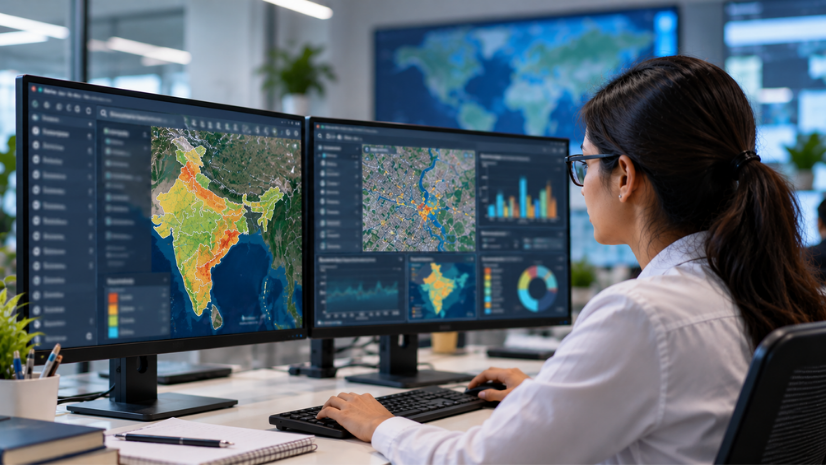
Driven by policy interventions and national initiatives, such as the National Geospatial Policy 2022 and the National Geospatial Program, the geospatial industry in India is currently witnessing unprecedented growth. Geospatial intelligence is also driving national-level development. Location intelligence solutions are becoming an intrinsic part of large government investments in infrastructure, roads, railways, smart cities, and utilities.
As a natural consequence, the demand for geospatial professionals is rising. This demand is getting accelerated by technology trends, such as the emergence of GeoAI, real‑time GIS, and Cloud GIS platforms. While real‑time GIS is allowing organizations to monitor dynamic systems such as transportation networks, utilities, and disaster response in real time, GeoAI is enabling automated extraction of insights from satellite imagery and spatial datasets. Cloud GIS platforms are fostering scalable collaboration, enterprise integration, and faster access to location intelligence. These new trends are stimulating changes not only in the ways geospatial education should be imparted, but also in how this education is to be imbibed.
Evolving Skill Sets for Modern Geospatial Professionals
As the role of GIS is changing from a mapping tool to a decision support tool, it is being realized that a multidisciplinary skill set is the need of the hour in the changing landscape of geospatial technology and applications. While a strong skill set in the fundamental principles of GIS and the management of spatial data is essential, it is now important that geospatial technology professionals should be proficient in programming, especially in the popular programming tool Python, in order to be effective in the changing role of geospatial technology. Geospatial professionals should also gain in-depth knowledge in the areas of urban development, agricultural development, infrastructure development, and environmental management.
As data from satellites, drones, IoT sensors, mobile devices, and enterprise systems becomes increasingly integrated for effective decision-making, geospatial professionals also need to gain a strong familiarity with standards, interoperability, and data governance. This would be an essential attribute. GIS is no longer a standalone system. As it gets increasingly integrated with enterprise platforms such as ERP, asset management, and digital twins, professionals who understand APIs, system integration, and enterprise architecture will be in high demand.
Role of Academia in Building Future Talent
To develop the next generation of geospatial professionals, a holistic approach is needed that considers the technical and interdisciplinary aspects of the field, as well as the interaction between the academic community and industry. To address the evolving industry’s needs, it is necessary to enhance geospatial curricula at universities and incorporate the latest developments in the geospatial field, including GeoAI, cloud computing, and real-time analytics. In addition, there is a need to ensure that the instructors are aware of the latest developments in the geospatial field. The best way to develop a balanced learning environment is through a multi-modal education system, combining theory, MOOCs, hands-on learning, internships, and instructor-based learning.
There is also a need to consider the idea of developing Centres of Excellence (CoEs) that focus on a specific industry, including urban, climate, agriculture, and infrastructure, which could help in the interactions between academia, government, and industry.
Conclusion
The rapid evolution of the geospatial ecosystem in India offers an opportunity as well as a challenge to create a workforce for the future. With the rapid evolution of technology and the subsequent evolution in the use of data for decision-making, the role of a geospatial professional is becoming strategic in nature. It, therefore, becomes imperative to take more concrete steps to bridge the gap between academic learning and industry needs. Organizations like the GIS Academia Council of India (GACI), which is supported by Esri India, can play a pivotal role in formulating more practical and forward-thinking recommendations to help academic institutions bridge the geospatial skills gap and ensure that the future workforce is equipped with the right tools to achieve this objective and play a pivotal role in developing a robust workforce for the future to help India achieve the leading position in this sphere.
Rajesh is Senior Director Strategy at Esri India with over 40 years of experience in the IT industry in India and overseas.