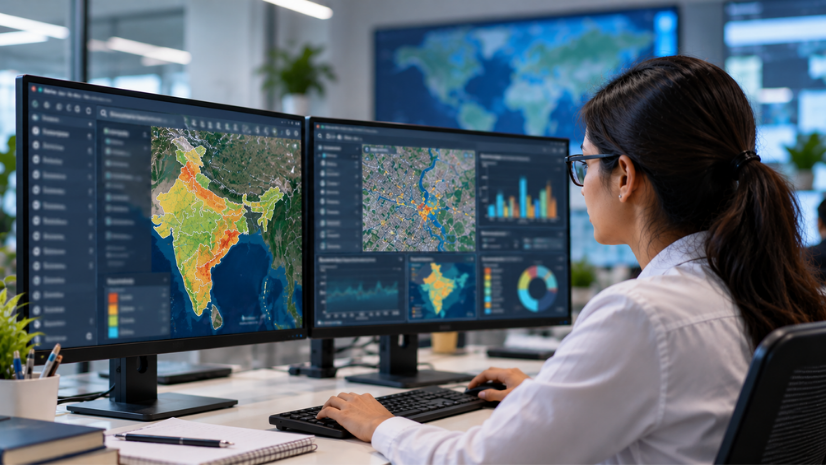
The FMCG Challenge of Reaching the Indian Shopper
India is one of the most complex FMCG (Fast-Moving Consumer Goods) markets in the world.
Over 12 million kirana stores form the backbone of Indian retail. Modern trade is expanding rapidly in metros and large cities. Tier 2 and Tier 3 towns are seeing rising disposable income and growing demand for branded goods. And rural markets, which account for a significant share of FMCG consumption, often sit at the end of distribution chains that were never designed to reach them efficiently.
For FMCG brands, the challenge is not just making the right product. It is getting that product to the right shelf, in the right location, at the right time, for the right consumer, consistently and at scale.
This is where location intelligence becomes a competitive advantage. By combining spatial data, demographic insights, and advanced analytics, location intelligence gives FMCG companies a precise, hyperlocal understanding of where demand exists, where distribution is failing, and where growth is waiting to be unlocked.
Esri’s ArcGIS is the technology powering this intelligence for some of India’s most competitive FMCG brands.
What Is Location Intelligence in FMCG?
Defining Location Intelligence
Location intelligence is the practice of using spatial data and geographic analytics to inform business decisions. It combines where consumers live, work, and shop, with what they buy, how much they earn, and how they behave, and makes all of it visible on a map.
For FMCG companies, location intelligence answers questions that traditional data analytics cannot. It tells you not just that sales are down in a region, but why: whether the nearest distributor is too far away, whether a competitor has opened a new outlet nearby, or whether the neighbourhood’s demographic profile has shifted away from your core consumer.
Why It Matters for FMCG Brands
India’s consumer base is not uniform. Purchasing behaviour, product preferences, price sensitivity, and brand loyalty vary dramatically across geographies, income bands, and cultural contexts. A strategy that works in South Mumbai may fail in Patna. A product format that sells in Bengaluru may need to be completely rethought for rural Rajasthan.
Hyperlocal targeting through location intelligence lets FMCG brands move beyond national averages and city-level strategies to design campaigns, assortments, and distribution plans that reflect the specific reality of each micromarket.
Role of GIS in FMCG Location Intelligence
GIS is the spatial layer that makes location intelligence operational. It maps every retail outlet, distributor depot, and competitor location in a region. It visualizes supply-demand gaps at the ward or pin code level. It models how demographic shifts will affect demand over time. And it connects all of this to the supply chain, territory planning, and marketing systems that drive day-to-day FMCG operations.
Key Challenges in FMCG Distribution and Retail in India
|
Challenge |
How Esri India Helps |
| Fragmented Retail Ecosystem | ArcGIS Business Analyst maps the entire retail landscape including kirana stores, modern trade outlets, and distributors spatially, enabling brands to visualize coverage gaps and prioritize outlet expansion |
| Inefficient Distribution Networks | ArcGIS spatial analytics models road networks, delivery times, and distribution center catchment areas to identify the most efficient routes and depot locations, reducing transportation costs and ensuring on-shelf availability |
| Poor Demand Forecasting | By combining demographic data, purchasing behaviour, and spatial growth patterns, ArcGIS helps brands forecast demand at the micromarket level rather than relying on city or state averages |
| Market Expansion Uncertainty | ArcGIS enables scenario-based market analysis that tests expansion decisions against real data on population, competition, accessibility, and spending power before any investment is committed |
How GIS Is Connecting the Shelf to the Shopper
Mapping the Entire FMCG Value Chain
The journey from factory to shelf involves dozens of spatial decisions: where to locate distribution centers, how to define sales territories, which outlets to prioritize for a new product launch, and how to route field sales teams most efficiently.
GIS maps every link in this chain spatially. Manufacturers can see the full distribution footprint, from primary distribution hubs to last-mile retail points, on a single map. Gaps, overlaps, and inefficiencies become visible immediately. Decisions that previously required weeks of analysis can be made in hours.
Demand-Supply Gap Analysis
One of the most powerful applications of GIS in FMCG is identifying where consumer demand exists but supply does not reach.
ArcGIS Business Analyst overlays population density, income levels, household composition, and purchasing behaviour data against existing distribution coverage to reveal underserved markets. A brand may discover that a high-income urban cluster is receiving adequate service while a growing peri-urban area with rising consumer spending is entirely outside its distribution footprint.
These gap analyses directly inform where to place new distributors, which routes to expand, and which markets to enter first.
Hyperlocal Consumer Insights
India’s consumer base is layered. Even within a single city, different neighbourhoods have sharply different consumer profiles. ArcGIS Business Analyst enables consumer segmentation at the pin code or ward level by combining census data, lifestyle and behavioural data, spending patterns, and demographic variables like age, income, household size, and purchasing preferences.
For FMCG brands, this means knowing that a health-conscious consumer cluster in one part of a city represents an opportunity for premium organic products, while a price-sensitive high-density neighbourhood a few kilometers away is better served by value packs and economy SKUs and being able to tailor distribution, assortment, and marketing accordingly.
Real-Time Visibility Across Distribution
ArcGIS Dashboards give FMCG supply chain teams a live, spatially referenced view of distribution performance. Sales representatives can see their territory performance on a map. Distribution managers can monitor which outlets are being serviced, which are overdue for a visit, and where stockouts are occurring. Regional heads can compare performance across territories and identify which ones need immediate intervention.
Real-time spatial visibility compresses the decision cycle from weekly reports to daily, actionable intelligence.
Use Cases of GIS for FMCG in India
FMCG Site Selection with GIS
Selecting the right location for a new distributor depot, company-owned outlet, or warehousing facility requires understanding multiple spatial factors simultaneously: proximity to target consumers, road accessibility, competitive environment, rental economics, and population growth trajectory.
ArcGIS Business Analyst performs multi-factor site suitability analysis, scoring candidate locations against each criterion and ranking them by overall fit. This reduces the risk of expensive location decisions made on intuition rather than evidence.
Sales Territory Planning
Poorly designed sales territories create imbalances: some representatives are overwhelmed while others are underutilized. Geographic inefficiencies drive up travel costs and reduce customer contact frequency.
ArcGIS enables territory design and optimization by balancing workload across sales teams based on outlet count, revenue potential, and drive time. Automated territory rebalancing workflows let brands adjust territory boundaries as the market evolves without starting from scratch every year.
Distribution Network Optimization
ArcGIS’ drive-time and network analysis tools model how changes to the distribution network will affect service coverage and delivery costs. Brands can test scenarios: what happens to delivery times if a new depot is opened in a specific location, or if an underperforming depot is consolidated with a neighbouring one?
These simulations let supply chain teams make structural decisions backed by spatial evidence, reducing both the cost and risk of distribution network changes.
Retail Performance Analysis
By mapping outlet-level sales data spatially, FMCG brands can identify patterns that tabular reports miss. Clusters of underperforming outlets may reveal a common factor: a nearby competitor’s expansion, a road access problem, or a demographic shift in the catchment area.
ArcGIS hotspot analysis and cluster mapping make these spatial patterns immediately visible, enabling brands to diagnose performance issues and design targeted interventions at the outlet level.
Market Expansion Strategy
Entering a new city or region is one of the highest-stakes decisions an FMCG brand makes. ArcGIS Business Analyst supports market expansion strategy by combining population data, income distribution, competitive density, distribution infrastructure, and trade area modeling to identify which markets offer the best combination of demand potential and accessible entry.
For brands moving into Tier 2 and Tier 3 cities, this spatial approach replaces guesswork with a rigorous, data-driven market entry prioritization framework.
Role of ArcGIS in FMCG Location Intelligence
ArcGIS Business Analyst for FMCG
ArcGIS Business Analyst is Esri’s purpose-built location intelligence platform for market planning, site selection, and customer segmentation. It combines demographic data, business data, lifestyle and spending data, and census data with map-based analytics through desktop, web, and mobile applications.
For FMCG brands, it provides tools for consumer profiling, market potential assessment, sales forecasting, drive-time analysis, trade area modeling, and territory design. With access to over 15,000 data variables across India, brands can validate location decisions with the depth of data that modern FMCG competition demands.
Spatial Analytics and Data Science
Esri India’s spatial analytics capabilities within ArcGIS support advanced FMCG analytics including hotspot analysis, cluster and outlier detection, spatial regression, and predictive demand modeling. These tools move location intelligence from visualization into genuine analytical insight, enabling brands to understand not just where consumers are but why sales perform the way they do in specific locations.
Integration with Business Systems
ArcGIS integrates with the CRM, ERP, and sales analytics systems that FMCG companies already operate. Outlet data from distribution management systems, sales performance data from ERP platforms, and consumer data from CRM tools can all be brought into ArcGIS’ spatial environment, giving the GIS a live connection to the operational data that matters most.
Dashboards and Visualization
ArcGIS Dashboards bring location intelligence out of the GIS team and into the hands of sales managers, marketing heads, and supply chain directors. Territory performance, outlet coverage, competitor activity, and consumer demographic data all appear on interactive maps that non-GIS users can navigate and act on without specialist training.
Benefits of GIS-Driven FMCG Strategies
Improved Distribution Efficiency
Spatial route optimization and depot placement analysis reduce last-mile delivery costs while improving on-shelf availability across a wider network of outlets.
Better Market Penetration
Demand-supply gap analysis reveals underserved markets and whitespace opportunities that would never surface in traditional sales reporting, enabling brands to expand reach before competitors do.
Enhanced Decision-Making
Every major FMCG decision, whether on distribution, site selection, territory design, or market entry, is made with spatial evidence rather than intuition or incomplete data.
Increased Sales and ROI
Hyperlocal consumer insights allow brands to tailor product assortment, pricing, and marketing to the specific profile of each micromarket, improving both hit rate and return on investment from marketing spend.
Competitive Advantage
Brands that can see the market spatially, identify gaps faster, respond to competitive moves more quickly, and serve consumers more precisely will consistently outperform those that cannot.
Real-World Scenarios: How FMCG Brands Use Location Intelligence
Expanding into Tier 2 and Tier 3 Cities
India’s growth story is increasingly playing out in smaller cities. ArcGIS Business Analyst helps brands identify which Tier 2 and Tier 3 cities offer the right combination of rising income, limited competition, and accessible distribution infrastructure for a profitable market entry. Rather than entering every adjacent city simultaneously, brands can prioritize the highest-potential markets with spatial evidence.
Optimizing Rural Distribution
Rural India accounts for a large share of FMCG consumption, but rural distribution is inherently complex. Long distances, poor road connectivity, low outlet density, and seasonal demand variations make efficient servicing difficult. ArcGIS network analysis models rural distribution routes, identifies the optimal locations for rural super-stockists, and flags areas where demand exists but service frequency is too low to sustain availability.
Launching New Products Strategically
A national product launch is expensive. A spatially intelligent launch targets the specific geographies where the target consumer profile is most concentrated, competition is least entrenched, and distribution infrastructure can support rapid market build. ArcGIS Business Analyst supports this by mapping consumer segmentation, competitor presence, and distribution capability simultaneously so launch teams can sequence their entry geography for maximum impact.
Challenges in Implementing GIS in FMCG
|
Challenge |
How Esri India Helps |
| Data Availability and Quality | Outlet and distributor data is often incomplete or out of date. ArcGIS data engineering tools support data cleaning, geocoding, and enrichment workflows that bring existing data up to the quality standard that spatial analysis requires |
| Integration with Legacy Systems | Many FMCG companies run distribution management on systems not designed to share data with a GIS platform. Esri India supports integration with standard business system formats and APIs, enabling brands to connect existing infrastructure to ArcGIS without replacing core operational systems |
| Skill Gaps in GIS | Location intelligence is only valuable if the people making decisions can access and interpret it. Esri India’s training programs build GIS and spatial analytics skills within sales, marketing, and supply chain teams, making location intelligence a capability that runs across the business rather than sitting in a specialist team alone |
| Change Management | Shifting an FMCG organization from gut-based to evidence-based decisions requires cultural change alongside technology adoption. ArcGIS Business Analyst’s web and mobile interfaces are designed for non-specialist users, reducing the adoption barrier and making spatial thinking a daily commercial habit |
The Future of Location Intelligence in FMCG India
Three trends will define the next wave of location intelligence in Indian FMCG.
AI and GIS powering demand forecasting: GeoAI models that combine spatial demographics, historical sales patterns, and real-time signals including weather, local events, and economic indicators will enable demand forecasting at the micromarket level with a precision that traditional forecasting models cannot match.
Quick commerce and e-commerce integration: As quick commerce expands into Tier 2 cities and e-commerce reshapes purchase journeys, FMCG brands will need location intelligence that spans both physical and digital channels, understanding how online demand signals relate to physical distribution coverage and vice versa.
Growth of hyperlocal GIS for rural India: As India’s rural digital infrastructure improves and more granular demographic data becomes available under the National Geospatial Policy 2022, GIS-driven rural FMCG strategies will become both more accurate and more operationally viable, opening up market opportunities that today remain difficult to quantify and serve.
Conclusion
In India’s highly fragmented, geographically diverse, and intensely competitive FMCG market, the difference between winning and losing often comes down to how well a brand understands and serves each specific location it operates in.
Location intelligence, powered by Esri’s ArcGIS Business Analyst, gives FMCG brands the spatial clarity to connect every shelf to the shopper it was placed there to serve. From site selection to territory planning, demand forecasting to rural distribution, GIS turns location from a background assumption into a front-line competitive advantage.
Ready to bring location intelligence into your FMCG strategy? Connect with Esri India to get started.
Frequently Asked Questions
What is location intelligence and how does it help FMCG companies in India?
Location intelligence is the use of spatial data and geographic analytics to inform business decisions. For FMCG companies in India, it reveals where demand exists, where distribution is failing, and where growth opportunities are underserved, enabling hyperlocal strategies that improve coverage, sales, and ROI across India’s fragmented retail landscape.
How does GIS help FMCG brands optimize their distribution network in India?
GIS maps the full distribution footprint spatially and uses network analysis to model delivery times, depot catchment areas, and route efficiency. ArcGIS Business Analyst identifies underserved markets, tests depot placement scenarios, and optimizes sales territory boundaries based on outlet density, revenue potential, and drive time.
What is ArcGIS Business Analyst and how is it used in FMCG?
ArcGIS Business Analyst is Esri’s location intelligence platform for market planning, site selection, and customer segmentation. It combines demographic, lifestyle, spending, and census data with map-based analytics. FMCG brands use it for consumer profiling, demand-supply gap analysis, competitor mapping, sales territory design, and new market entry strategy.
How does GIS support retail site selection and market expansion in India?
GIS performs multi-factor suitability analysis for site selection, scoring candidate locations against population density, income levels, competitor presence, road accessibility, and demand forecasts. For market expansion, ArcGIS Business Analyst identifies which Tier 2 and Tier 3 cities offer the best combination of demand potential, distribution infrastructure, and competitive whitespace.
What are the challenges of implementing location intelligence in India’s FMCG sector?
The main challenges are incomplete or inconsistent outlet and distributor data, difficulty integrating GIS with legacy distribution management systems, skill gaps in spatial analytics across commercial teams, and cultural resistance to evidence-based decision-making. Esri India addresses these through data engineering tools, open integration APIs, accessible web and mobile interfaces, and structured training programs.
Written by
Esri India Marketing