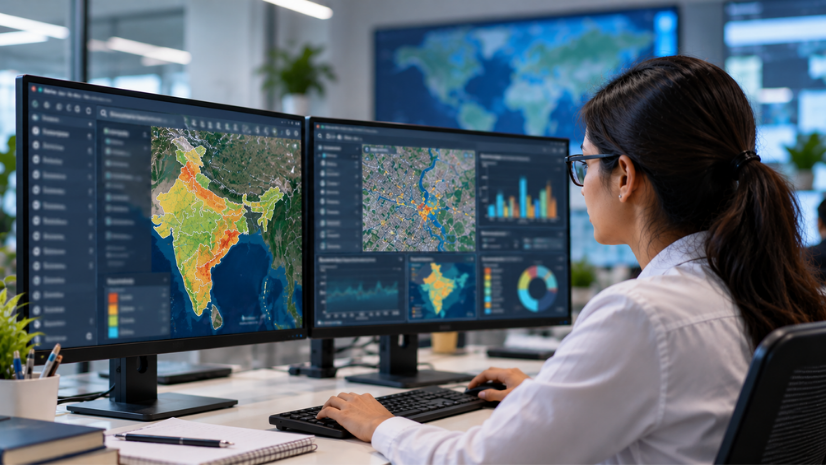
GIS for Census 2027 means using geographic information system technology to define, map, and manage the spatial units of census enumeration, geo-tag every structure and household, monitor field progress in near real time, and build the spatial foundation that turns raw demographic counts into a national data fabric usable by planners, ministries, and communities for the next decade.
India’s First Digital Census and the GIS Revolution
The Census 2027, the world’s largest census exercise, is under way. The Government of India commenced Phase I of Census 2027, the Houselisting and Housing Census (HLO), from April 1, 2026, marking the beginning of the country’s largest administrative and statistical exercise. This is India’s first ever digital data capture and Self-Enumeration.
Census 2027 will be the 16th in the series of Indian censuses and the 8th since Independence. It introduces several pioneering features, including mobile-based data collection, near real-time monitoring through the Census Management and Monitoring System (CMMS) portal, an optional Self-Enumeration facility, and extensive use of geo-referenced jurisdictions.
The shift from paper-based enumeration to a fully digital, geospatially grounded exercise is not merely an administrative upgrade. It is a fundamental change in what the census can deliver: spatially precise, verifiable, near-real-time data that connects individual households to their geographic context for the first time in India’s census history.
What Is GIS for Census and Official Statistics?
GIS for census and official statistics means using geographic information system (GIS) technology to define the geographic units of enumeration, verify coverage without gaps or duplication, monitor field operations spatially, and produce data outputs that are queryable and visualizable at any administrative geography, from the national level down to the individual enumeration block.
For a country the size and geographic diversity of India, this spatial layer is what makes it possible to ensure that no habitation, colony, or remote settlement falls outside the census count, and that all the data collected can be aggregated, compared, and made useful at the precise geographic levels that planners and policymakers need.
Census 2027: A Quick Overview
Census 2027 will be conducted in a structured two-phase format. Phase I, the Houselisting and Housing Census, is scheduled between April and September 2026, held over 30 days in each state and union territory. Phase II, Population Enumeration, is scheduled for February 2027, capturing detailed demographic, socio-economic, cultural, migration, and fertility-related information. The reference date for Census 2027 has been fixed as 00:00 hours of March 1, 2027.
The Union Cabinet has approved a financial outlay of ₹11,718.24 crore for its implementation. The Census Act, 1948, and the Census Rules, 1990, govern the exercise. Under Section 15 of the Census Act, personal information provided by respondents is treated as strictly confidential. It cannot be made public under the Right to Information (RTI) Act, used as evidence in any court of law, or shared with any institution.
The exercise is conducted by the Office of the Registrar General and Census Commissioner of India (RGI) under the Ministry of Home Affairs, with implementation in close collaboration with state and union territory governments
How GIS Modernises the Census Workflow
The HLB Creator: Replacing Sketch Maps with Satellite Intelligence
The most significant GIS innovation in Census 2027 is the replacement of hand-drawn sketch maps with a dedicated satellite imagery-based mapping application.
The Houselisting Block Creator (HLBC) is a web mapping application used by Charge Officers. It facilitates the digital creation of Houselisting Blocks (HLBs) using satellite imagery, ensuring geographic coverage across the country without omission or duplication.
In previous censuses, Charge Officers drew notional sketch maps of HLBs by hand. These maps were inconsistent in scale, could not be verified for completeness, and left no auditable spatial record of what each enumerator was responsible for. The HLB Creator replaces this with a precision digital workflow where every HLB is defined as a polygon on satellite imagery, with its boundaries precisely delineated, its enclosed structures visible, and its geographic relationship to adjacent blocks verifiable.
GIS-based analytical tools provide the environment for training officials in spatial boundary creation, verifying HLB completeness against administrative boundary datasets, and identifying geographic areas that may be under-assigned or overlapping between charge boundaries. Satellite imagery basemaps, administrative boundary layers, and demographic context data support spatial training exercises and completeness verification.
Geo-Tagging Every Building and Household
Beyond block-level boundary creation, Census 2027 introduces geo-tagging of individual structures during the Houselisting phase. Each building visited by an enumerator is assigned a GPS coordinate, creating for the first time a nationally comprehensive, geo-referenced registry of India’s built environment.
This geo-tagged building dataset is structurally significant beyond the census itself. It becomes the spatial anchor for cross-linking Census 2027 household data with Pradhan Mantri Awas Yojana-Gramin (PMAY-G) and Pradhan Mantri Awas Yojana-Urban (PMAY-U) housing scheme beneficiary records, Jal Jeevan Mission tap water connection data, Mahatma Gandhi National Rural Employment Guarantee Act (MGNREGA) asset registries, Ayushman Bharat Digital Mission (ABDM) health IDs, and Atal Bhujal Yojana well-level water security records. Every government programme whose beneficiary universe is defined by households gains a spatial identity through Census 2027’s geo-tagging architecture.
From Houselisting to Population Enumeration: The GIS Layer
The Self-Enumeration and Field Confirmation Loop
The Self-Enumeration exercise is a secure, web-based facility available in 16 regional languages. Respondents can log in to the portal se.census.gov.in using their mobile number and basic credentials. Upon successful submission, a unique Self-Enumeration ID (SE ID) is generated, which is shared with the enumerator during the subsequent field visit for confirmation.
GIS connects these two flows on the CMMS portal. When a household completes self-enumeration online, their SE ID is spatially registered against the HLB to which their address belongs. When the enumerator visits in the field, they confirm the SE record against the geo-tagged building coordinate, updating the HLB’s completion status on the CMMS dashboard. The spatial match between citizen-submitted data and enumerator-confirmed field observation creates an auditable, location-indexed verification record.
GPS-enabled field data capture apps provide the technical framework for structured data collection by census enumerators, with built-in validation checks, offline capability for areas with limited connectivity, and automatic synchronisation to the central CMMS database when connectivity is restored.
CMMS: Near Real-Time Spatial Monitoring
The Census Management and Monitoring System (CMMS) portal has been developed to manage and monitor the entire census process on a near real-time basis. Officers at sub-district, district, state, and national levels can track enumeration progress, field performance, and operational readiness through an integrated dashboard.
Geospatial visualisation tools turn the CMMS’s incoming data streams into geographically intelligible operational pictures. At the district level, a Charge Officer can see which HLBs in their jurisdiction are complete, which are in progress, and which are yet to be initiated. At the state level, the Census Director can monitor coverage percentages across districts. At the national level, the Registrar General’s office can track the exercise’s progress against the state-by-state schedule.
Continuous GPS data streams from field enumerators’ mobile devices enable supervisors to verify that field staff are physically visiting assigned HLBs rather than submitting data remotely. This spatial verification of field presence is a data quality control function unique to the digital census model.
Beyond the Census: GIS for MoSPI Surveys and Official Statistics
The GIS modernisation of India’s official statistics system extends well beyond the decennial census.
Urban Frame Survey
In February 2024, the National Sample Survey Office (NSSO) under the Ministry of Statistics and Programme Implementation (MoSPI) signed a Memorandum of Understanding (MoU) with the National Remote Sensing Centre (NRSC) under the Indian Space Research Organisation (ISRO) to conduct the Urban Frame Survey (UFS) in digital mode using geo-ICT tools on the Bhuvan geospatial platform. The current UFS phase from 2022 to 2027 plans survey work for around 8,134 towns using improved mobile, desktop, and web-based GIS solutions. The MoU covers the development of mobile applications for geo-tagging of NSSO Urban Frame Survey data, web portal visualisation, system-generated scrutiny and editing, and fine-tuning of block, IV-unit, ward, and town boundaries using high-resolution satellite imagery.
CAPI-enabled surveys
National Sample Surveys (NSS) are being conducted using Computer Assisted Personal Interviewing (CAPI). The e-SIGMA platform, with built-in validation checks, real-time data submission, AI-enabled chatbots, and multilingual interfaces, has significantly improved data quality and facilitated the timely release of survey results. Sampling designs have been strengthened to enable monthly, quarterly, and district-level estimates. Annual survey results are now released within 90 to 120 days, quarterly results within 45 to 60 days, and monthly results within 15 to 30 days of survey completion.
Geo-referenced sampling frame design supports stratified area-frame surveys that ensure representative geographic coverage across the full range of urban settlement types, from megacities to census towns.
Census 2027 as a Spatial Planning Fabric
The geo-tagged Census 2027 dataset does more than count India’s population. It becomes the common spatial reference that allows multiple national programmes to locate their beneficiaries, verify coverage, identify gaps, and plan targeting at the village, ward, and block level.
Open data and public-facing visualisation platforms allow aggregated, non-confidential Census 2027 outputs to be published for policymakers, researchers, and development practitioners. Geo-referenced census data on housing conditions, access to water, sanitation, electricity, and digital connectivity can be overlaid with programme delivery data to identify where infrastructure gaps and welfare deficits coincide, driving evidence-based targeting for PMAY, Jal Jeevan Mission, and National Digital Literacy Mission interventions.
The Pradhan Mantri Gati Shakti (PM Gati Shakti) National Master Plan’s multimodal infrastructure planning layer gains its sharpest population density and demand surface from Census 2027’s household-level geo-tagged data, enabling transport, logistics, and energy corridor planning to be grounded in the most current spatial representation of where India’s population lives and works.
Benefits for Policymakers, Planners, and Citizens
For census administration
Near real-time CMMS dashboards replace the weeks-long data gap of paper census operations with day-by-day coverage visibility. Geo-tagged HLB completion maps identify which areas need supervisory attention before field operations close.
For state and district planners
Census 2027’s geo-referenced data at sub-district and village level, linked to housing condition and amenity indicators, directly informs state annual plans, district development plans, and urban master plan revisions with the most granular, up-to-date spatial population evidence available.
For citizens
The Self-Enumeration portal at se.census.gov.in, available in 16 languages, gives households the convenience of completing their census obligations digitally, reducing the burden of enumerator visits and ensuring that household data is accurately recorded without transcription errors from paper forms.
For researchers and data users
The combination of geo-referenced HLB boundaries, geo-tagged building coordinates, and CMMS-verified enumeration records creates a spatial census dataset of unprecedented precision, enabling academic research, private sector market analysis, and development programme evaluation at geographic resolutions that the 2011 Census could not support.
Data Security and Privacy Architecture
A comprehensive, multi-layered data security framework has been established for Census 2027. This includes end-to-end encryption covering data collection, transmission, and storage, along with secure transmission protocols to prevent unauthorised access. Data is hosted on certified, secure data centres, which have been designated as Critical Information Infrastructure (CII), ensuring heightened protection standards. These systems comply with the globally recognised ISO/IEC 27001:2022 standards and are subject to regular security audits.
Individual-level census data collected under the Census Act, 1948 remains permanently protected under Section 15. No GIS visualisation tool or analytical platform can expose individual household records. Every spatial implementation for census data works exclusively with aggregated, anonymised outputs at the HLB, village, sub-district, or higher geographic level.
Challenges and the Road Ahead
Connectivity in remote areas
India’s forest tracts, island territories, mountain communities, and coastal hamlets present connectivity challenges for real-time data submission from enumerators’ mobile devices. Offline-first app design, with local data storage and automatic synchronisation when connectivity is available, is essential for CMMS completeness in the most geographically challenging enumeration areas.
HLB quality consistency across states
The HLB Creator is a significant advance over hand-drawn sketch maps, but the quality of HLBs varies with the training and satellite literacy of individual Charge Officers. Ensuring that HLBs created by 34 lakh enumerators across India’s enormous geographic diversity meet consistent standards of coverage and precision requires robust training, validation workflows, and CMMS-based quality checking before field operations begin.
MoSPI sampling frame currency
The Urban Frame Survey and Rural Frame Survey provide the geographic sampling frames for the Periodic Labour Force Survey (PLFS), the Household Consumption Expenditure Survey (HCES), and other NSS surveys. Keeping these geo-referenced frames current in rapidly changing urban environments, where new colonies, resettled communities, and informal settlements appear faster than five-year survey cycles can capture, remains a sustained challenge requiring more frequent remote sensing-based update workflows.
Census-to-planning pipeline
The full value of a geo-referenced census is realised when its spatial outputs are integrated with programme delivery datasets across ministries. Building the data governance agreements, application programming interface (API) linkages, and integration architecture that connect Census 2027’s geo-tagged data to Jal Jeevan Mission, PMAY, MGNREGA, and ABDM registries requires inter-ministry coordination that is as much an institutional challenge as a technical one.
FAQs
1.What is Census 2027 in India?
Census 2027 is India’s 16th population census and the first fully digital one, using mobile-based data collection, a Self-Enumeration portal, and a Census Management and Monitoring System (CMMS) for real-time field tracking. Phase I (Houselisting) runs from April to September 2026, with Population Enumeration scheduled for February 2027.
2.How is GIS used in the Indian census?
GIS powers Census 2027 through the Houselisting Block Creator (HLBC), a web mapping application using satellite imagery to digitally define and geo-reference enumeration units, replacing hand-drawn sketch maps used in all previous censuses. GPS-enabled mobile apps geo-tag every building visited, creating India’s first national geo-referenced building registry.
3.What is Digital Layout Mapping (DLM) in Census 2027?
Digital Layout Mapping (DLM) uses the HLB Creator web mapping application and geo-referenced satellite imagery to define precise polygon boundaries for each Houselisting Block, replacing hand-drawn sketch maps from previous censuses. This ensures every geographic area is assigned to exactly one enumerator with verifiable spatial boundaries.
4.How does geo-tagging help in census enumeration?
Geo-tagging assigns GPS coordinates to every building visited during enumeration, enabling supervisors to verify enumerator presence and confirm full coverage within each Houselisting Block. It also connects Census 2027 household data to programme delivery records from Jal Jeevan Mission, PMAY, and MGNREGA for planning and evaluation.
5.Which agency conducts the Census of India?
The Census of India is conducted by the Office of the Registrar General and Census Commissioner of India (RGI) under the Ministry of Home Affairs, implemented through state directorates and approximately 34 lakh field enumerators. The legal framework is the Census Act, 1948, under which all individual-level data is strictly confidential.
Written by
Esri India Marketing