Agriculture continues to be the backbone of Indian economy contributing up to 18.2% of Gross Value Added (GVA) and providing livelihoods to almost 45% of India’s workforce. More than an economic activity, agriculture in India remains a lifeline for millions of people and a critical pillar of nation’s food security framework. Most critically, agriculture is the central component of the development strategies of major states there by underscoring the interconnection of agriculture and state development.
Having information on how much area has been sown, cropping pattern, estimated yield, and others are crucial data for critical activity like policy-based resource allocation, crop insurance planning, risk mitigation, national food security and disaster response and recovery. Currently, the crop statistics, by Directorate of Economics and Statistics (DES), are still largely derived from manual surveys and sample-based reporting. Such reporting is time-consuming and lack accuracy which creates delays in the decision-making process.
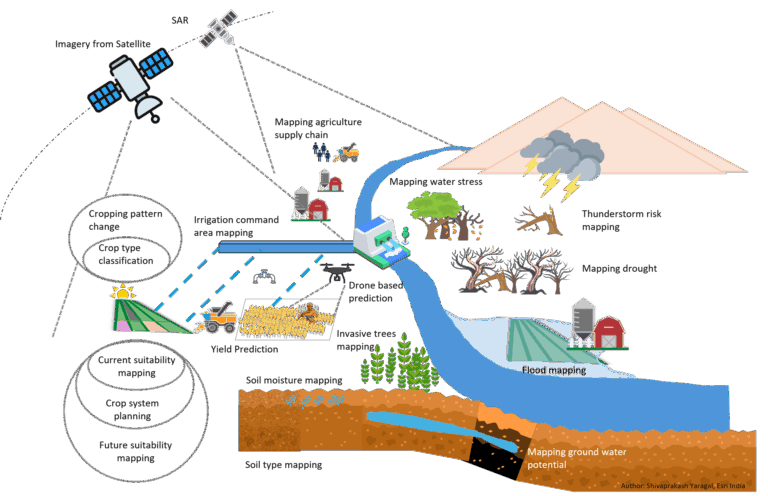
What could be the solution? Agriculture should be viewed as an integrated system that depends on the foundational agriculture datasets involving maps that capture crop area, crop types, soil characteristics, water stress, flood risk, drought vulnerability, irrigation mapping, ground water mapping and many more. These datasets, as depicted in Figure 1, for building any effective agricultural system. By establishing this comprehensive data foundation, stakeholders can shift from fragmented, manual reporting toward a more accurate, consistent, and scalable approach that supports informed decision-making.
Crop Type Classification
Crop type classification is the process of identifying different crops grown on agricultural land using remotely sensed data like satellite data, areal imagery and drone data. Being a dynamic and season-specific activity, crop type mapping is crucial tool for yield estimation, understanding shifting cropping pattern, managing production and handling of regional food security.
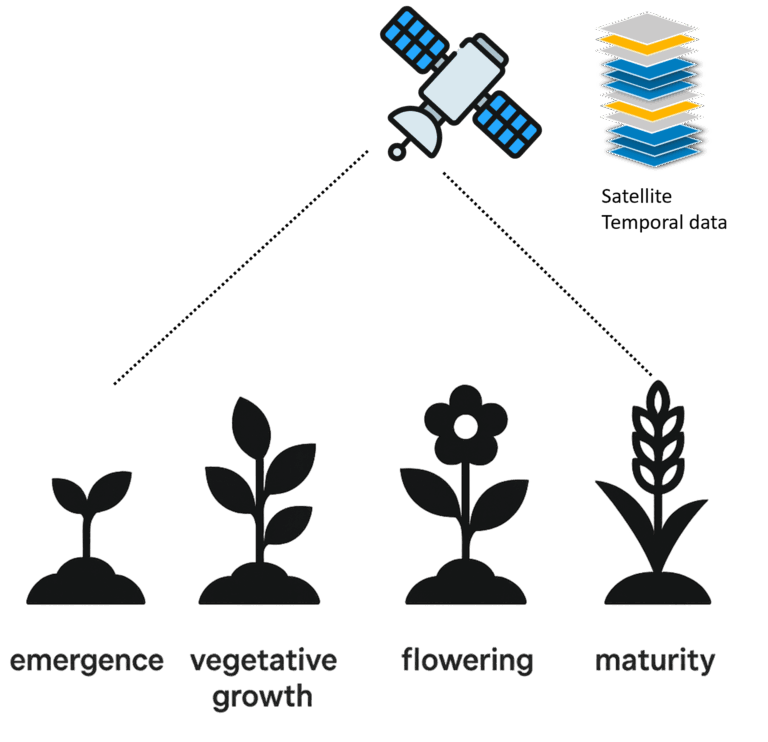
Process of crop-type classification has been built on the unique spectral, structural and temporal behaviour of the various crops as they progress through different phenological stages of emergence, vegetation growth, flowering and maturity. Satellites with different capturing methods and high revisit can capture these behaviours from the space and hence are foundation to development of the crop type maps at regional scale.
Indian Scenario
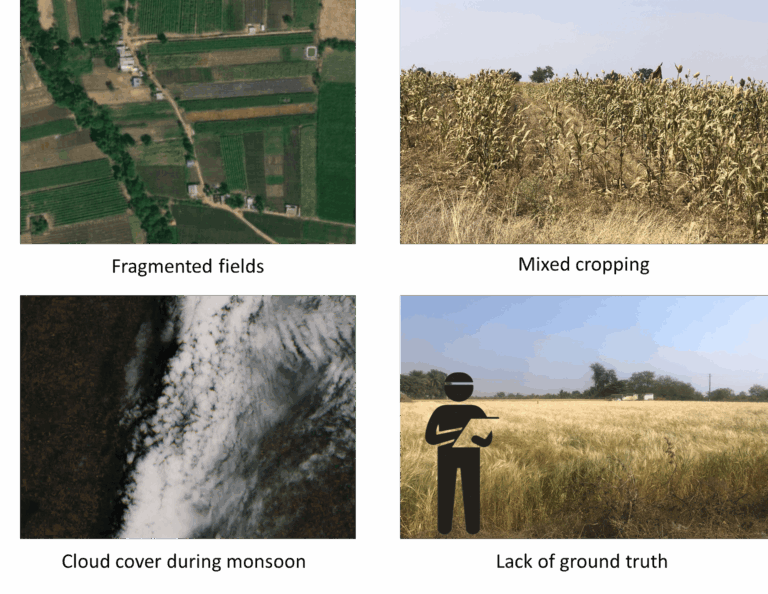
Generating accurate crop type maps in India presents unique challenges
- Highly fragmented agricultural landholdings: Most Indian farmers cultivate very small parcels of land (averaging around 0.74 hectares). Representing such small and fragmented holdings accurately using satellite data is difficult.
- Prevalence of multi-cropping and diverse cropping systems: India has three major cropping seasons – Kharif, Rabi, and Zaid. Within these broad categories, numerous agro-ecological zones support different dominant crops. In many regions, farmers grow two crops in the same field or cultivate very short-duration crops in quick succession, making crop-type classification using Earth observation data even more challenging.
- Heavy cloud cover during the monsoon: Cloud cover can reach up to 70% across India during the peak monsoon months (July to October), significantly limiting the usability of optical satellite imagery.
- Limited availability of reliable ground reference data: Field-level crop labels are often not collected, and when they are, they may contain substantial inaccuracies. This limits the creation of high-quality training and validation datasets.
Satellite Data availability for crop classification
Open satellite data is the primary source for developing crop-type maps at regional and national scales. Sentinel-2, a medium‑resolution (10 to 60 meters) optical sensor with 13 spectral bands, is well-suited for capturing crop phenology and vegetation health. Its frequent revisit cycle enables multiple observations during a growing season. However, during the peak monsoon period, the use of Sentinel-2 imagery becomes limited due to heavy cloud cover. Sentinel-1, a Synthetic Aperture Radar (SAR) mission, is unaffected by cloud conditions and is highly sensitive to crop structure, plant density, and soil moisture. These characteristics make Sentinel-1 data particularly valuable for crop mapping, especially during the monsoon season.
The Landsat satellite series also provides 30-meter resolution imagery with nine spectral bands and is highly useful for generating national‑level crop maps. The U.S. Cropland Data Layer (CDL), developed by the National Agricultural Statistics Service (NASS), is one of the best examples of Landsat data being used for national‑scale crop‑type mapping. Similarly, Canada’s Annual Crop Inventory is another successful initiative where Landsat data has been effectively utilized to produce nationwide crop maps.
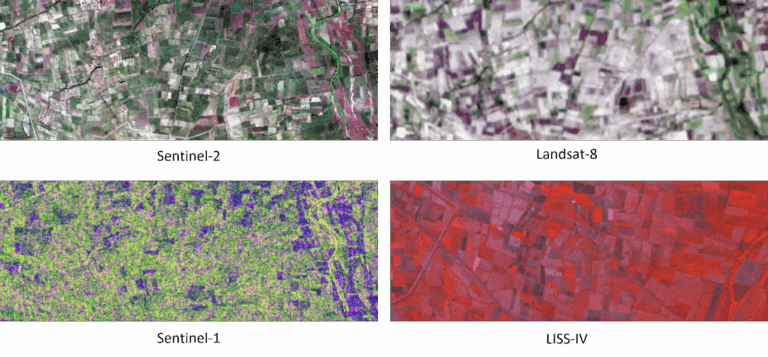
A newer dataset, known as the Harmonized Landsat-Sentinel-2 (HLS) dataset, combines observations from both Landsat and Sentinel-2 missions. This harmonization results in a high-frequency, dense time series, making it particularly suitable for crop classification and monitoring. In addition to these freely available global datasets, the Government of India also provides LISS-IV imagery at no cost. LISS-IV offers a fine spatial resolution of 5.8 meters with three spectral bands and a revisit cycle of five days. This dataset is also valuable for crop classification applications. Table 1 gives the information of the satellite data that can be used for the crop classification.
| Type of sensor | Spatial resolution | Number of bands | Temporal revisit | |
| Sentinel-2 | Optical | 10 to 60 meters | 13 bands | 5 days |
| Sentinel-1 | Radar (SAR) | 10 meters | 2 bands | 6 days |
| Landsat | Optical | 30 meters | 9 bands | 16 days |
| LISS-IV | Optical | 5.8 meters | 3 bands | 5 days |
GeoAI for Crop Classification in Esri Ecosystem
The Esri ecosystem provides advanced tools and capabilities to discover, ingest, and classify satellite data. These datasets may include single-scene images or multi-dimensional satellite data collections. The GeoAI tools in ArcGIS Pro enable users to design and implement GeoAI-based crop classification workflows.
For crop-type classification, Esri provides the Prithvi Foundation Model[1] through the ArcGIS Living Atlas[2]. This model was developed in collaboration with NASA and IBM. The Prithvi foundation model can be adapted for downstream applications such as crop classification and
[1] Prithvi – Crop Classification
[2] ArcGIS Living Atlas of the World
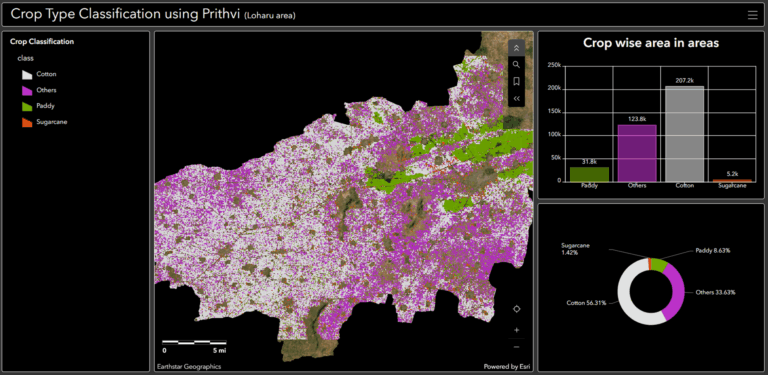
can be fine-tuned to regional requirements. The input to this model is a composite raster consisting of three-time steps, each containing six bands, resulting in a total of 18 bands from the Harmonized Landsat-8 dataset. Figure 5 shows the ArcGIS Dashboard for the Prithvi foundation model applied to the Loharu region of Haryana to identify crops such as cotton, paddy, and sugarcane.
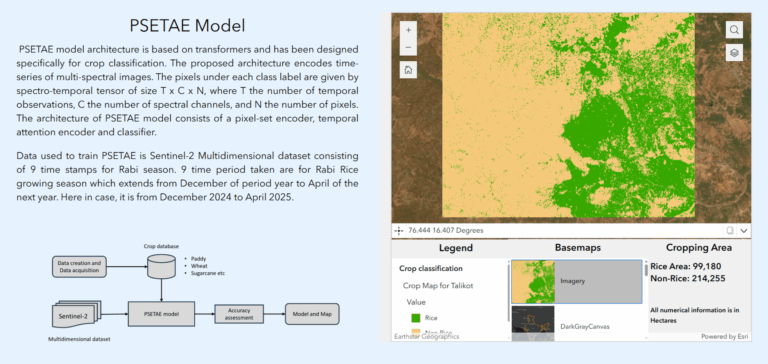
The Esri ecosystem also allows seamless integration of the Pixel-set Encoder and Temporal Attention Encoder (PSETAE[1]), a state-or-the-art transformer-based model specifically designed for crop-type classification. PSETAE operates on spectral-spatial and temporal data. As a model that processes data in parallel, it is highly efficient in handling Satellite Image Time Series (SITS). In PSETAE, instead of analysing individual pixels, the model operates on sets of pixels extracted from agricultural fields and uses temporal attention mechanisms to learn crop-growth patterns over time. This enables the model to accurately identify crop types. The PSETAE approach is particularly effective in fragmented landholding systems such as that are found in India.
We applied the PSETAE model to generate a Rice vs. Non-Rice classification map using Sentinel-2 temporal data with nine timestamps spanning from December 2024 to April 2025. Figure 6 shows the application output, displaying the rice and non‑rice crop map for the Talikot–Hunasagi region in Karnataka.
Future development
Bringing spatial and temporal generalization into crop-type classification remains one of the biggest challenges. A model developed using data from one region should be able to make inferences on data from another region. Similarly, a model trained on Kharif season data should ideally work for Rabi or Zaid seasons. A model trained on data from a single year – such as 2024 – should be capable of producing reliable predictions for satellite data from 2025-26. Achieving such generalized crop-type predictions is challenging. Therefore, there is a need for a framework that can support location-specific, geo-adapted crop-type classification models capable of operating across multiple satellite-data pipelines.
Conclusion
Crop-type classification is a strategic capability for the development of Indian agriculture. By combining open satellite data, advanced GeoAI models, and ArcGIS-based data pipelines, it is now possible to generate reliable crop-type maps at scale. Such outputs will play a crucial role in strengthening food security, supporting agricultural planning, and enabling climate-resilient agricultural development across the country.

Shivaprakash, manager on the Presales team, designs India-specific GIS solutions for Esri India customers.