It is easy to take electricity for granted. We flip a switch, the lights turn on, and we move on. For those responsible for keeping the lights on, this simplicity hides a difficult question: how much power will people need in the future? Getting this wrong can mean overloaded networks, costly upgrades, or wasted investment.
The answers to this question already exist. Years of electricity consumption data quietly captured how demand has evolved over time. The challenge is not data availability. The real challenge is making sense of it.
Time-MoE: A Game Changer for Time-Series Forecasting
Forecasting electricity demand is not a new problem, but it has never been an easy one. Demand rises and falls for many reasons like population growth, economic activity, seasonal patterns, and changing consumer behavior. Traditional forecasting methods often struggle to capture these complex, long-term patterns, while deep learning models usually demand large training datasets and heavy computational resources.
This is where Time Series Forecasting (Time-MoE) model changes the story.
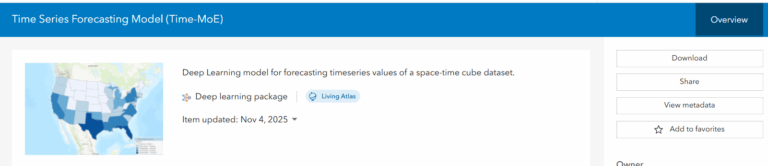
Integrated directly into ArcGIS, Time-MoE is a pretrained time-series foundation model designed to deliver high-quality forecasts without the need for retraining or fine-tuning. Instead of learning from scratch every time, the model already comes with a deep understanding of how time-based data behaves across real-world scenarios. This intelligence comes from its training on Time-300B, a massive corpus containing more than 300 billion time points across diverse domains, including energy systems.
From a user’s perspective, the process feels refreshingly simple. You provide historical consumption values, and the model focuses on learning the rhythm of that data. There is no long training phase, no tuning cycles, and no trial-and-error. The intelligence is already there, quietly working in the background.
What makes this especially useful is how naturally it handles the historical data. Years of electricity consumption are not treated as isolated numbers, but as a continuous journey. Time-MoE looks at where demand has been, understands how it has changed, and then extends that story into the future considering both short & long-term variations.
Forecasting Electricity Consumption Using ArcGIS
With the model in place, the next step was to apply it to a real-world problem: Forecasting electricity demand for an area of interest in Bengaluru. The starting point was historical electricity demand data in Million Units (MU) covering the years 2010 to 2023. Each dataset point reflects how electricity usage responded to changing conditions such as population growth, economic activity, and evolving consumption habits.
Rather than viewing these values as standalone numbers, ArcGIS organizes the data as a continuous timeline. This allows the forecasting model to see how demand has moved over time to identify patterns like where it has grown steadily, where it has slowed, and where noticeable shifts have occurred. By preserving this sequence, the model can understand the overall direction and rhythm of electricity consumption.
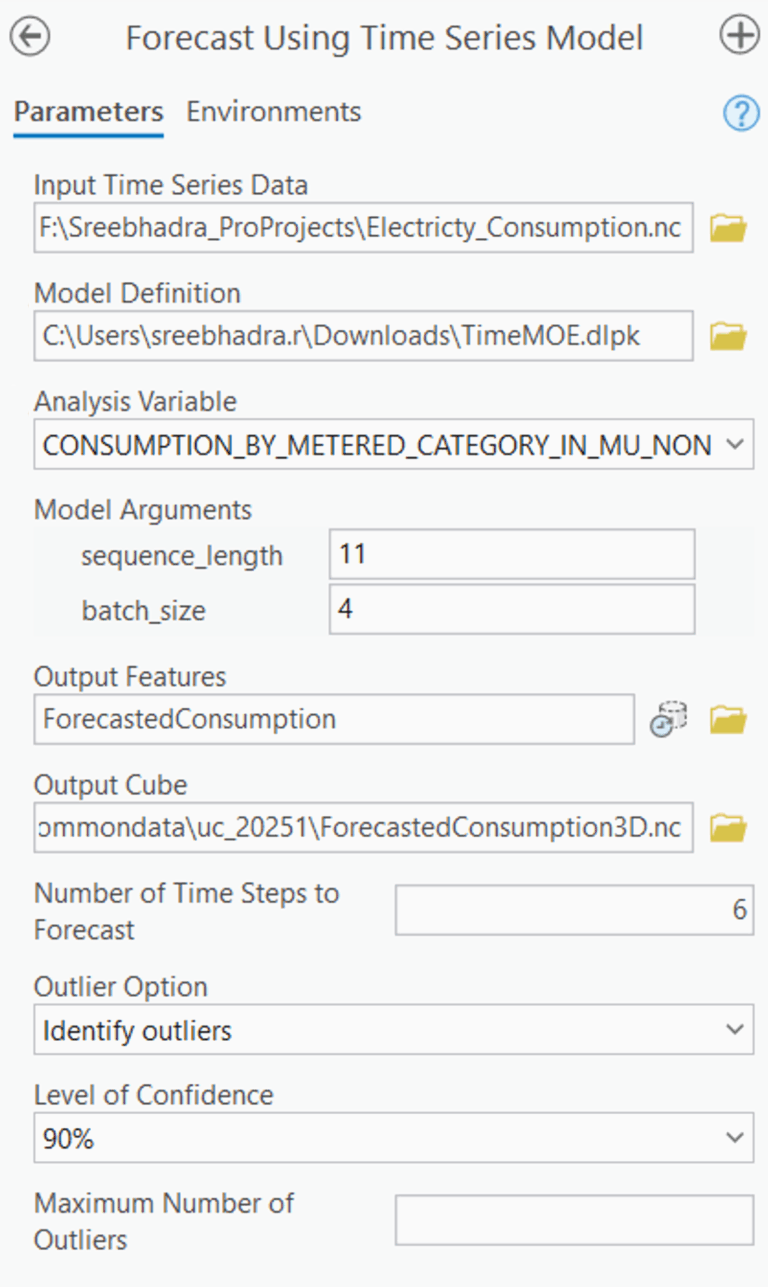
Using the Forecast Using Time Series Model tool in ArcGIS and the Time-MoE model, future electricity demand for the region of interest was projected beyond the historical record. The model first learned how consumption behaved between 2010 to 2023. Then it carried that story forward to forecast the electricity demand all the way from 2024 up to 2029. Rather than guessing what comes next, the model builds on over ten years of actual consumption to shape a far more realistic view of the future. The real advantage of this model lies in its simplicity. Using just two inputs – year and consumption, it was able to forecast electricity demand for the next five years.
To ensure the forecasts were reliable, the predicted demand for 2024 was compared against the actual consumption for the year 2024. The model forecasted 26,100 MU, while the recorded value was 25,963 MU. This very small difference demonstrates how closely the model’s predictions align with reality, building confidence in its ability to forecast future demand accurately.
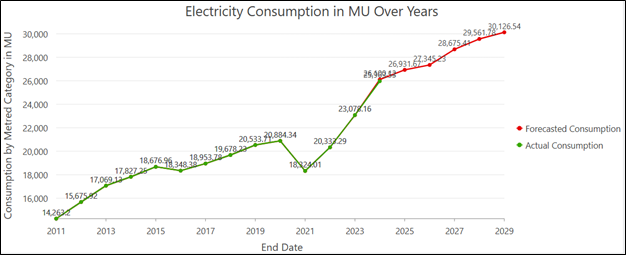
The resulting graph makes this journey easy to follow. The green line traces the actual electricity consumption over the years, showing how demand has steadily changed based on real usage. Extending from that, the red line steps in to represent the forecast, carrying the story forward into the coming years. Together, the two lines create a clear visual narrative to show where demand has been, and the other shows where it is likely headed next.
The real strength of this workflow lies in how seamlessly it fits into everyday planning. Historical electricity data is no longer confined to reports or charts; it becomes a living input for thinking ahead, testing scenarios, and planning with confidence. By bringing forecasting directly into the ArcGIS environment, planners are no longer switching between tools or mindsets; insight and action come together in one place. And in a domain where reliability, timing, and preparedness truly matter, this quiet shift transforms how the future is planned.

Sreebhadra is a Senior Engineer and works on translating GeoAI capabilities into practical ArcGIS solutions.